
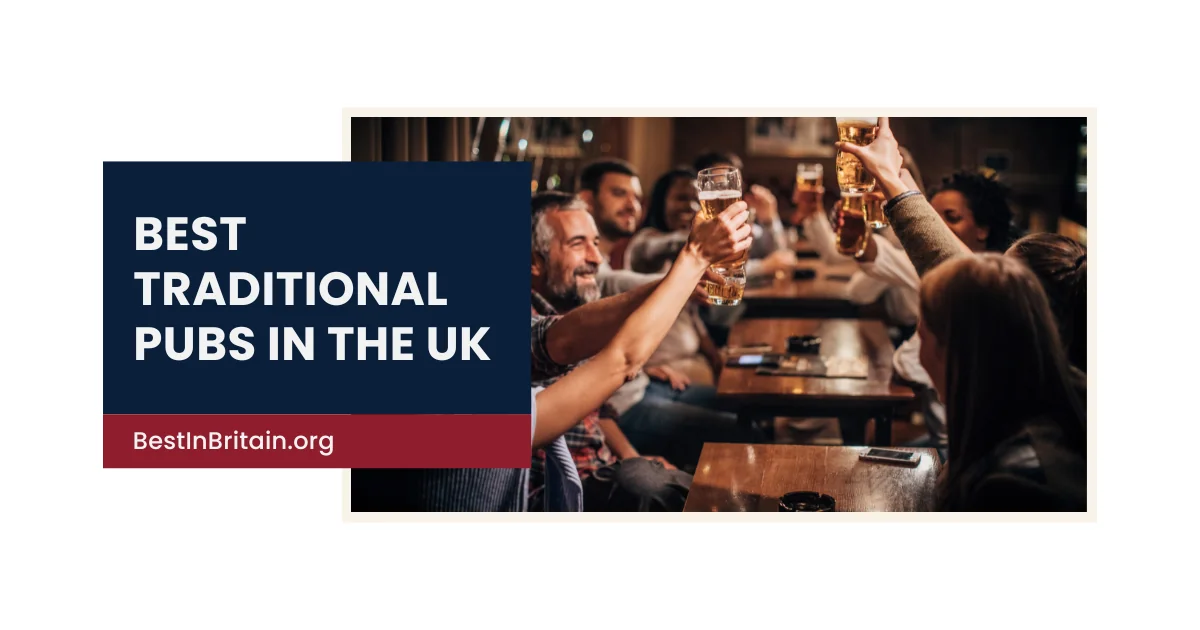
The traditional British pub is difficult to define neatly. Age matters, but an old building does not automatically make a good pub. Timber beams, etched glass and open fires can create atmosphere, yet the deeper character comes from how the place is used: regulars talking at the bar, local beer being pulled properly, walkers arriving with muddy boots and rooms that still encourage conversation rather than behaving like a themed restaurant.
The strongest traditional pubs have usually changed without losing their identity. They may serve better food than they did a generation ago, welcome families and visitors more openly or occupy buildings restored after years of neglect. What matters is that the bar remains central and the pub still feels connected to its neighbourhood, village or landscape.
This guide brings together 30 of the best traditional pubs in the UK. The selection includes nationally important historic interiors, city drinking palaces, rural inns, coastal pubs and community-owned establishments across England, Scotland, Wales and Northern Ireland.
Opening hours, food service and beer ranges change regularly. Some rural pubs close between lunch and evening service or operate reduced winter hours, so check directly before making a long journey.
How we selected the best traditional pubs in the UK
Our editorial assessment considered:
- Pub character: A genuine bar-led atmosphere rather than a restaurant that happens to serve beer.
- Historic interest: Surviving interiors, architecture or a long relationship with the surrounding community.
- Drinks: Well-kept cask ale, regional beer, whisky, cider or another drinks offer suited to the pub.
- Sense of place: A pub that feels rooted in its city, village, coast or landscape.
- Community role: Regular local use, traditional games, music, conversation or community ownership.
- Food balance: Good pub food where offered, without allowing dining to overwhelm the bar.
- Visitor experience: A pub worth seeking out while still feeling like a real public house.
- Geographical range: Strong representation from all four nations of the UK.
CAMRA maintains a national inventory of pubs with historically important interiors. Inclusion in this guide is broader: heritage matters, but so do atmosphere, drinks, continuity and community life.
Traditional pubs in London
1. The George Inn, Southwark
Location: Borough High Street, Southwark
Best for: A surviving galleried coaching-inn setting
The George is London's last surviving galleried inn and one of the capital's most immediately recognisable historic pubs. It stands within a courtyard off Borough High Street, close to Borough Market and London Bridge.
The present building dates largely from the 17th century and preserves the long external galleries associated with coaching inns. Travellers once arrived through this part of Southwark before crossing into the City, making the location as significant as the architecture.
Inside, the pub is divided into several rooms rather than one vast open bar. The courtyard becomes lively in warm weather, although the quieter interiors communicate the building's history more clearly.
Why it stands out:
The George provides a rare physical link with the coaching-inn culture that once shaped the roads south of the Thames.
Good to know:
Its location makes it extremely busy around lunch and after work. Visit earlier on a weekday to appreciate the rooms and galleries with more space.
2. The Princess Louise, Holborn
Location: High Holborn, London
Best for: Etched glass, tiled interiors and Victorian pub design
The Princess Louise is one of London's great Victorian pub interiors. Ornamental tiling, mirrors, etched glass and carved wood divide the ground floor into intimate drinking compartments.
The partitions are not merely decorative. They demonstrate how pubs once separated different groups and forms of drinking within the same building. Restoration has retained this room-like character rather than turning the interior into a single modern bar.
As a Samuel Smith pub, the drinks range comes largely from the brewery's own portfolio. The experience is therefore as distinctive operationally as it is architecturally.
Why it stands out:
Few pubs allow visitors to experience the compartmentalised layout and decorative ambition of a late-Victorian London drinking house so clearly.
Good to know:
House policies and payment arrangements can differ from other pubs. Check current information and avoid expecting a mainstream branded beer range.
3. The Black Friar, Blackfriars
Location: Queen Victoria Street, London
Best for: Art Nouveau decoration and one of London's most unusual pub interiors
The Black Friar occupies a narrow triangular building close to Blackfriars station. Its exterior figure of a friar hints at the richly decorated interior, where mosaics, reliefs and mottos create an unusually theatrical drinking space.
The pub was remodelled during the early 20th century in an Arts and Crafts and Art Nouveau spirit. Curved walls and gleaming decoration make the rear room particularly memorable.
Its central location attracts commuters and visitors, but the building remains more than a convenient station pub.
Why it stands out:
The Black Friar is architecturally unlike any other traditional London pub and rewards close inspection beyond the main bar.
Good to know:
The interior is compact and can fill rapidly after work. Quieter daytime visits make the decorative details easier to see.
4. Ye Olde Cheshire Cheese, Fleet Street
Location: Wine Office Court, Fleet Street
Best for: Cellars, small rooms and old Fleet Street atmosphere
Ye Olde Cheshire Cheese was rebuilt shortly after the Great Fire of London and developed into a maze of low rooms, passages and cellars behind Fleet Street.
Its literary reputation has grown through associations with writers and journalists, some better documented than others. The stronger reason to visit is the building itself. Dark panelling, narrow staircases and separate rooms preserve the feeling of a pub used by different groups over generations.
The pub's hidden-court entrance makes the transition from busy Fleet Street especially effective.
Why it stands out:
It offers one of central London's most convincing enclosed tavern atmospheres, with a layout that encourages exploration.
Good to know:
Do not stop at the first bar. The lower rooms and cellars are central to the experience, subject to current access.
5. The Seven Stars, Holborn
Location: Carey Street, beside the Royal Courts of Justice
Best for: A tiny independent pub with legal-London character
The Seven Stars is a compact pub close to Lincoln's Inn and the Royal Courts of Justice. Its small rooms, idiosyncratic decoration and long association with lawyers give it a character far removed from London's larger managed houses.
Food is taken seriously, but the pub retains the intimacy and unpredictability of an independent local. Shelves, pictures and closely arranged tables make the interior feel accumulated rather than designed in one campaign.
Why it stands out:
The Seven Stars remains personal, eccentric and closely tied to the professional district around it.
Good to know:
Space is limited and the pub can become crowded at court-closing time. Food service and table availability should be checked in advance.
Traditional pubs in southern England
6. The Fleece Inn, Bretforton, Worcestershire
Location: Bretforton, near Evesham
Best for: Folk traditions, timber framing and a living village pub
The Fleece is a half-timbered former farmhouse owned by the National Trust and operated as a working pub. The building became licensed during the 19th century, although the structure itself is considerably older.
Low ceilings, settles, pewter and fireplaces give the rooms a deeply traditional appearance. More importantly, the inn maintains an active programme of folk music, Morris dancing and community events.
The surrounding Vale of Evesham is reflected in seasonal food and the pub's association with local asparagus.
Why it stands out:
The Fleece is not simply a preserved old building. Music, customs and village use keep the pub's traditions active.
Good to know:
Events can make the inn extremely busy. Book food and check the calendar when travelling specifically for a quieter visit.
7. The Square and Compass, Worth Matravers, Dorset
Location: Worth Matravers, Isle of Purbeck
Best for: Cider, stone rooms and coastal-walk atmosphere
The Square and Compass is a famously individual Dorset pub in a stone building above the Jurassic Coast. Drink is commonly served through a hatch, while simple rooms, benches and a large garden keep the arrangement closer to an old alehouse than a conventional dining pub.
Local cider is central to its identity. Food is deliberately limited compared with a gastropub, reinforcing the pub's role as a drinking stop for walkers and regulars.
A small fossil collection adds another layer of local character without turning the building into a themed attraction.
Why it stands out:
The Square and Compass has resisted the pressure to become a polished coastal restaurant and remains one of southern England's most distinctive rural pubs.
Good to know:
Do not arrive expecting a full menu. Check opening and food arrangements, and approach respectfully through the small village.
8. The Bell Inn, Aldworth, Berkshire
Location: Aldworth, Berkshire
Best for: A quiet, family-run village-pub experience
The Bell sits in a small Berkshire village on the edge of the North Wessex Downs. Its simple rooms, settles, fireplaces and long family stewardship have helped preserve an atmosphere that feels unusually unforced.
This is the kind of pub where beer and conversation remain more important than elaborate branding. Food, when served, supports the pub without reshaping it into a restaurant.
Walkers can combine the visit with countryside routes and the nearby church, known for its medieval effigies.
Why it stands out:
The Bell represents the traditional village local at its most convincing: small, hospitable and resistant to unnecessary reinvention.
Good to know:
Opening and food hours may be limited. Check directly before travelling from a distance.
9. The Blue Anchor, Helston, Cornwall
Location: Coinagehall Street, Helston
Best for: Historic brewing tradition and distinctive Cornish ale
The Blue Anchor is closely associated with Spingo ales brewed on the premises. Its identity is therefore rooted not only in the age and layout of the pub but also in a continuing local brewing tradition.
Low rooms, dark wood and multiple bars create a classic Cornish inn atmosphere. Spingo can be stronger and more distinctive than familiar session ales, so first-time visitors should ask about the available styles and measures.
Helston's historic centre and proximity to the Lizard make the pub a strong stop within a wider Cornwall itinerary.
Why it stands out:
The relationship between pub and brewery gives the Blue Anchor a character that cannot be reproduced by décor alone.
Good to know:
Treat stronger ales with care, particularly when driving. Current tours, food and accommodation arrangements should be checked directly.
10. The Royal Oak, Wantage, Oxfordshire
Location: Near Wantage, Oxfordshire
Best for: Country walks, local beer and an unpretentious rural stop
The Royal Oak occupies a rural setting near the Berkshire Downs and attracts walkers, cyclists and local residents. Traditional features and a strong emphasis on beer keep it grounded as a country pub even where the food offer has developed.
Its appeal lies less in one spectacular historic room than in the overall balance of bar, food, garden and surrounding landscape.
Why it stands out:
The Royal Oak demonstrates that a traditional pub can serve thoughtful food without losing its identity as a place for a pint.
Good to know:
There are several pubs with this name in the region. Confirm the address and current service times before setting out.
11. The King's Head, Aylesbury, Buckinghamshire
Location: Market Square, Aylesbury
Best for: Coaching-inn architecture and a historic courtyard
The King's Head is one of England's best-preserved coaching inns, with origins in the 15th century. Its courtyard, gate passage, timber structure and surviving historic details reveal how travellers, horses and trade once moved through the complex.
The pub remains in use rather than existing solely as a heritage property. This gives visitors the chance to appreciate its architecture in the context for which much of it was intended.
Why it stands out:
The King's Head preserves the scale and circulation of a major market-town coaching inn more completely than most surviving examples.
Good to know:
Explore beyond the front bar and look into the courtyard. Opening arrangements for different sections can vary.
Traditional pubs in the Midlands and eastern England
12. Ye Olde Trip to Jerusalem, Nottingham
Location: Brewhouse Yard, beneath Nottingham Castle
Best for: Rock-cut rooms and Nottingham legend
Ye Olde Trip to Jerusalem is built into sandstone caves beneath Nottingham Castle. Its name and age are surrounded by colourful claims that are difficult to prove in full, but the physical setting is genuinely distinctive.
Rooms extend into the rock, and objects, stories and supposed supernatural associations have accumulated around the pub over time. The strongest experience comes from examining how the building uses the caves rather than concentrating on unsupported title claims.
Why it stands out:
Very few British pubs are integrated so dramatically into the geology and defensive landscape of a city.
Good to know:
It is a major visitor attraction and can become busy. The caves and different rooms are more interesting than a quick drink at the entrance.
13. The Bartons Arms, Birmingham
Location: High Street, Aston
Best for: Glazed tilework and a magnificent urban pub interior
The Bartons Arms is one of Birmingham's great surviving public houses. Built at the beginning of the 20th century, it contains elaborate tilework, mirrors, woodwork and separate rooms associated with the city's pub-building confidence during the industrial era.
Its location outside the central leisure district makes the survival of such an interior especially valuable. The pub has also become known for serving Thai food, an example of a historic building developing a new culinary identity without losing its bar character.
Why it stands out:
The Bartons Arms combines nationally important decoration with a living, multicultural Birmingham pub experience.
Good to know:
Check current opening and kitchen days before travelling. Event nights and performances at nearby venues can increase demand.
14. The Nutshell, Bury St Edmunds, Suffolk
Location: The Traverse, Bury St Edmunds
Best for: Tiny proportions and a memorable quick pint
The Nutshell is widely known for its extremely small bar. Its narrow frontage and compact interior make the pub feel more like a densely packed cabinet of local curiosities than a conventional drinking room.
The small scale means conversation between strangers is almost inevitable. Decorations and objects fill the limited wall space, giving the pub an eccentric personality.
It works best as one stop within a wider Bury St Edmunds pub route rather than somewhere to gather with a large group.
Why it stands out:
The Nutshell turns physical limitation into atmosphere and provides one of the most distinctive small-pub experiences in Britain.
Good to know:
Large groups should divide or choose another venue. Busy periods can leave almost no standing space.
15. The Vine, West Bromwich
Location: Roebuck Street, West Bromwich
Best for: Traditional rooms and Punjabi barbecue
The Vine combines the structure and sociability of a traditional Black Country pub with a long-established Punjabi food offer. Its separate rooms and straightforward bar atmosphere remain central, while grills and curries draw customers from far beyond the immediate neighbourhood.
This combination is not a departure from British pub tradition but part of its continuing development. Across the West Midlands, Punjabi pubs have become an important regional form, shaped by local communities and industrial history.
Why it stands out:
The Vine demonstrates how a traditional pub can evolve through migration and local culture without losing its public-house identity.
Good to know:
Food is a major reason for visiting and the pub can become busy. Check current service times and booking arrangements.
Traditional pubs in northern England
16. The Philharmonic Dining Rooms, Liverpool
Location: Hope Street, Liverpool
Best for: Victorian grandeur and ornate drinking rooms
Known locally as the Phil, this Liverpool landmark is one of Britain's most elaborate city pubs. Mosaic floors, carved wood, stained glass and decorative plasterwork reflect the confidence of late-Victorian Liverpool.
A series of rooms preserves some of the social division built into grand pubs of the period. Even the historic men's lavatories are noted for their decorative quality, although access should obviously be respectful.
The pub's position opposite the Philharmonic Hall and between the cathedrals makes it part of the cultural identity of Hope Street.
Why it stands out:
The Phil is a genuine drinking palace, combining architectural extravagance with the relaxed familiarity of a city local.
Good to know:
Concert nights can make the pub extremely busy. Visit during the day for a clearer view of the interior.
17. The Marble Arch Inn, Manchester
Location: Rochdale Road, Manchester
Best for: Sloping mosaic floors and independent beer
The Marble Arch Inn is known for its striking tiled interior and noticeably sloping mosaic floor. The building retains the decorative quality of a late-19th-century urban pub while serving beers associated with Marble Brewery.
Its long, relatively narrow room makes the floor's changing level especially obvious. Decorative walls and ceiling details reward a slower look once the initial visual surprise has passed.
Why it stands out:
The pub combines an important historic interior with a drinks identity shaped by modern independent brewing.
Good to know:
The location sits outside the main central pub clusters. Check current food and opening arrangements before the walk from the city centre.
18. The Tan Hill Inn, North Yorkshire
Location: Arkengarthdale, North Yorkshire
Best for: Remote moorland atmosphere and an overnight pub trip
The Tan Hill Inn stands high in the North Pennines between Yorkshire and County Durham. Its isolated setting has become the defining feature, particularly in winter when severe weather can temporarily cut off the road.
Stone walls, fires and the surrounding open moorland create a powerful sense of refuge. The pub offers food, drink, music and accommodation, making it more practical to experience as an overnight stop than a rushed drive.
Why it stands out:
Few British pubs are shaped so completely by exposure, altitude and the journey required to reach them.
Good to know:
Check road and weather conditions carefully. Do not treat winter travel to Tan Hill as an ordinary drive.
19. The Olde Ship Inn, Seahouses, Northumberland
Location: Main Street, Seahouses
Best for: Maritime character and a Northumberland coast itinerary
The Olde Ship reflects Seahouses' relationship with fishing and the sea. Nautical objects, timber and tightly arranged rooms create the atmosphere of a maritime inn without relying entirely on modern decoration.
Local beer, seafood and the proximity of the harbour connect the pub to its setting. It is a natural stop before or after trips towards the Farne Islands, Bamburgh or the coastal paths.
Why it stands out:
The pub's character grows directly from the working and maritime history of Seahouses.
Good to know:
The village becomes extremely busy during holiday periods. Book rooms or meals well ahead when staying on the coast.
20. The Crown Inn, Hesket Newmarket, Cumbria
Location: Hesket Newmarket, Cumbria
Best for: Community ownership and locally brewed beer
The Crown became one of Britain's early community-owned pubs and remains closely linked with the village and Hesket Newmarket Brewery.
Its rooms retain the feel of a Cumbrian local, while the ownership model has helped protect the building as a social centre rather than viewing it only as a commercial asset.
The pub is well placed for walkers exploring the quieter northern fells and the area around Caldbeck.
Why it stands out:
The Crown shows how community ownership can preserve the social purpose of a rural pub while supporting local brewing.
Good to know:
Rural transport is limited. Check meal times and accommodation availability before planning a walk around the pub.
21. The Old Dungeon Ghyll Hotel, Great Langdale, Cumbria
Location: Great Langdale, Lake District
Best for: Fell walkers, simple beer and mountain history
The Old Dungeon Ghyll is deeply embedded in Lake District climbing and walking culture. Its walkers' bar is the key attraction for those seeking a traditional pub atmosphere rather than the more formal hotel spaces.
Boots, outdoor clothing, dogs and route discussions form part of everyday life. The surrounding Langdale Pikes give the pub one of the strongest mountain settings in England.
Why it stands out:
The Old Dungeon Ghyll is not merely near the fells; it remains part of the social infrastructure of British mountain walking.
Good to know:
Parking and valley roads become busy in good weather. Use local bus services where practical and check food hours after long walks.
Traditional pubs in Scotland
22. The Sheep Heid Inn, Edinburgh
Location: Duddingston, Edinburgh
Best for: Historic village atmosphere within the capital
The Sheep Heid sits in Duddingston beneath Arthur's Seat, an area that retains a village character despite being within Edinburgh.
The inn's long history is accompanied by an old skittle alley, fireplaces and a sequence of rooms suited to both drinks and meals. It is more polished than some pubs in this guide, but its location and continued role within Duddingston keep it rooted in place.
A visit pairs naturally with a walk around Holyrood Park or Duddingston Loch.
Why it stands out:
The Sheep Heid offers the feel of a historic village inn without leaving Edinburgh.
Good to know:
Food and the skittle alley are popular, so booking is advisable. Walkers should check the safest route after dark.
23. Café Royal, Edinburgh
Location: West Register Street, Edinburgh
Best for: Victorian decoration and a central oyster-and-ale stop
Café Royal occupies a richly decorated room close to Princes Street. Stained glass, tilework, mirrors and circular paintings create one of Edinburgh's most handsome pub interiors.
The food offer, particularly oysters and seafood, has long been part of its identity. Despite the grand surroundings, the bar remains welcoming for a drink without a full meal.
Why it stands out:
Café Royal preserves the decorative confidence of a Victorian city bar while continuing to work as a busy central pub.
Good to know:
The bar can fill rapidly after work and during festivals. Earlier visits provide more opportunity to see the interior.
24. The Clachaig Inn, Glencoe
Location: Glencoe, Highland
Best for: Walkers, climbers, live music and Highland atmosphere
The Clachaig Inn sits within one of Scotland's most dramatic mountain landscapes. Its bars have long served walkers, climbers, residents and travellers moving through Glencoe.
The Boots Bar is the most informal space, with outdoor clothing, dogs, beer and live music contributing to the atmosphere. Food and accommodation make the inn a practical base as well as a pub.
The Clachaig's strength comes from use rather than decoration. It feels traditional because mountain journeys, weather and conversation continue to shape the room.
Why it stands out:
Few Highland pubs remain so closely integrated with climbing, walking and the landscape immediately outside.
Good to know:
The glen is busy during summer and weekends. Book accommodation and meals early, and never rely on walking back along an unsafe road after drinking.
25. The Drovers Inn, Inverarnan
Location: Inverarnan, north of Loch Lomond
Best for: Dark historic atmosphere and West Highland journeys
The Drovers Inn occupies a stone building on a route once used by Highland cattle drovers. Its crowded collection of objects, dark wood and uneven historic atmosphere create a memorable stop on the road north.
Some of the inn's stories lean heavily into legend and ghostly folklore. The more convincing appeal lies in its role as a stopping place at the edge of the Highlands and its proximity to the West Highland Way.
Why it stands out:
The Drovers has the enclosed, weathered atmosphere many travellers imagine when picturing an old Highland inn.
Good to know:
It is popular with tour groups and road travellers. Visit outside peak arrival times for a calmer experience.
26. The Old Forge, Inverie, Knoydart
Location: Inverie, Knoydart
Best for: Community ownership and a pub reached by boat or long walk
The Old Forge stands in Inverie on the Knoydart peninsula, an area without a direct public-road connection to the wider mainland network. Most visitors arrive by boat from Mallaig or on foot through the mountains.
The pub is community-owned, strengthening its role as a meeting place for residents as well as travellers. Food, local drink, music and conversation are shaped by the realities of an isolated coastal community.
The journey is essential to understanding the pub. It should not be treated as a novelty checklist stop detached from Knoydart itself.
Why it stands out:
The Old Forge combines an extraordinary location with a community ownership model that protects the pub's local purpose.
Good to know:
Ferry schedules, weather and accommodation must be planned carefully. Do not assume a late boat or an easy alternative route will be available.
Traditional pubs in Wales
27. Black Boy Inn, Caernarfon
Location: Northgate Street, Caernarfon
Best for: Historic town-wall atmosphere and north Wales food
The Black Boy Inn stands within Caernarfon's medieval walls and has been part of town life for centuries. Low beams, stonework and a sequence of rooms create the feeling of an established coaching inn rather than a modern themed pub.
The substantial food offer and rooms make it a useful base for visiting Caernarfon Castle, Eryri and the Llŷn Peninsula. Welsh produce and local drinks help connect the inn with the region.
Why it stands out:
The Black Boy combines genuine historic character with the practical warmth of a busy north Wales inn.
Good to know:
The building's age creates changes in level and constrained spaces. Check accessibility and book ahead during the main visitor season.
28. Tŷ Coch Inn, Porthdinllaen, Gwynedd
Location: Porthdinllaen, Llŷn Peninsula
Best for: Beachfront drinking and a car-free coastal approach
Tŷ Coch Inn sits directly beside the beach at Porthdinllaen, with views across the bay and towards the mountains of north Wales.
Its appeal is inseparable from the approach. Most visitors walk from the National Trust parking area at Morfa Nefyn or arrive along the coast, creating a clear transition from road travel to a small maritime settlement.
The pub is simple and heavily dependent on weather and season. On a fine day, outdoor tables can become exceptionally busy.
Why it stands out:
Few pubs in Britain occupy such an immediate and beautiful relationship with the beach and sea.
Good to know:
There is no ordinary customer parking beside the pub. Check walking routes, tides, weather and seasonal hours before visiting.
29. The Skirrid Mountain Inn, Llanvihangel Crucorney
Location: Near Abergavenny, Monmouthshire
Best for: Old-inn atmosphere and a Bannau Brycheiniog itinerary
The Skirrid Mountain Inn stands near the eastern edge of Bannau Brycheiniog and is surrounded by stories of courts, punishment, travellers and ghosts.
Claims about its precise age and status as Wales's oldest pub should be treated cautiously, but the building's low rooms, beams, fireplaces and roadside position create a convincing historic atmosphere.
It works best as part of a wider journey through the Black Mountains, Abergavenny and the border country.
Why it stands out:
The Skirrid provides one of Wales's most strongly atmospheric traditional-inn experiences, even when legend is separated from verifiable history.
Good to know:
The pub actively embraces its supernatural reputation. Visitors more interested in architecture and beer may prefer quieter daytime periods.
Traditional pubs in Northern Ireland
30. The Crown Liquor Saloon, Belfast
Location: Great Victoria Street, Belfast
Best for: Ornate Victorian design and Belfast pub heritage
The Crown Liquor Saloon is one of the UK's most important historic pub interiors. Colourful tilework, stained and etched glass, carved wood, mirrors and private snugs create a remarkably complete late-Victorian drinking palace.
The National Trust owns the building, while the pub continues to operate commercially. This arrangement helps protect the interior without turning it into a static museum.
Its position opposite the Grand Opera House makes the Crown a natural Belfast landmark, although popularity can make spontaneous seating difficult.
Why it stands out:
The Crown preserves the architecture and social layout of a grand Victorian pub at a level few working public houses can match.
Good to know:
Visit near opening for the best chance to see or sit within the snugs. At busy times, appreciate the pub patiently rather than blocking circulation for photographs.
Northern Irish pubs that narrowly missed the main list
Northern Ireland has more excellent traditional pubs than one numbered entry can represent. Strong additions to a Belfast or regional itinerary include:
- The Garrick in Belfast
- Kelly's Cellars in Belfast
- The Duke of York in Belfast
- Whites Tavern in Belfast
- The John Hewitt in Belfast
- The Crosskeys Inn near Toome
- The Harbour Bar in Portrush
- Grace Neill's in Donaghadee
- Peadar O'Donnell's in Derry
- The Brewer's House in Donaghmore
These pubs vary from heritage interiors and music bars to community locals. Current ownership, opening hours and food arrangements should be checked individually.
Other traditional pubs worth visiting
A list of 30 inevitably leaves out many outstanding pubs. Further choices include:
- The Palm Tree in Mile End, London
- The Grenadier in Belgravia, London
- The French House in Soho, London
- The Harp in Covent Garden, London
- The Salisbury in Harringay, London
- The Red Lion in Lacock, Wiltshire
- The Nobody Inn in Doddiscombsleigh, Devon
- The Warren House Inn on Dartmoor
- The Ship Inn at Mousehole, Cornwall
- The Pandora Inn near Falmouth
- The Star Inn at Vogue, Cornwall
- The Harrow at Steep, Hampshire
- The Old Swan at Minster Lovell, Oxfordshire
- The Eagle Tavern at Little Coxwell, Oxfordshire
- The Old Joint Stock in Birmingham
- The Beacon Hotel in Sedgley
- The Great Western in Wolverhampton
- The Coopers Tavern in Burton upon Trent
- The Blue Bell in York
- The Golden Lion in Settle
- The Sun Inn in Dent
- The Birch Hall Inn at Beck Hole
- The Lion Inn at Blakey Ridge
- The Free Trade Inn in Newcastle
- The Cumberland Arms in Newcastle
- The Bridge Inn at Topsham
- The Globe Inn in Dumfries
- The Guildford Arms in Edinburgh
- The Kay's Bar in Edinburgh
- The Laurieston Bar in Glasgow
- The Scotia Bar in Glasgow
- Sandy Bell's in Edinburgh
- The Ship Inn at Red Wharf Bay, Anglesey
- The Golden Lion in Llangynhafal
- The Nag's Head Inn at Garthmyl
- Tafarn Sinc in Rosebush
- The Cross Inn at Penally
- Bunch of Grapes in Pontypridd
Best traditional pubs for different experiences
Best historic pub interior
The Crown Liquor Saloon, Princess Louise, Philharmonic Dining Rooms and Bartons Arms contain some of the most important surviving decorative interiors.
Best traditional London pub
The George Inn offers the strongest historic setting, while the Princess Louise is the leading choice for Victorian interior design.
Best rural village pub
The Bell at Aldworth and the Fleece at Bretforton offer especially convincing village-pub experiences.
Best walking pub
The Old Dungeon Ghyll, Clachaig Inn, Square and Compass and Crown Inn at Hesket Newmarket are deeply connected with surrounding walking country.
Best coastal pub
Tŷ Coch Inn provides the most spectacular beach setting. The Olde Ship in Seahouses offers stronger maritime interior character.
Best community-owned pub
The Old Forge and Crown Inn at Hesket Newmarket show how local ownership can preserve a pub's social value.
Best pub for traditional beer
The Blue Anchor's Spingo ales, the Marble Arch's independent brewing connection and community-linked beer at Hesket Newmarket provide distinct experiences.
Best pub for food without losing pub character
The Vine in West Bromwich, Bartons Arms and several regional inns prove that a serious kitchen can coexist with a proper bar.
What makes a pub traditional?
Traditional does not have to mean unchanged.
Separate rooms
Older pubs often contain a public bar, lounge, snug or other divided drinking spaces. These layouts encourage smaller groups and conversation.
A visible bar
The bar remains the centre of the room rather than a service counter hidden behind restaurant tables.
Local drinks
Regional beer, cider, whisky or other drinks help connect the pub with its area.
Regular local use
A traditional pub needs regulars. Without them, even a beautiful historic interior can feel like a visitor exhibit.
Games and music
Darts, dominoes, skittles, folk music and informal sessions can preserve social traditions when they arise naturally from the community.
Food in proportion
Many excellent traditional pubs serve good meals. Problems arise only when every drinking space is converted into reserved restaurant seating.
Accumulated interiors
Photographs, trophies, signs and objects gathered over decades often feel more authentic than newly purchased “vintage” decoration.
A pub does not need all these qualities. The strongest examples usually combine several in a way that feels natural rather than staged.
Pub etiquette for visitors
British pub etiquette is informal, but a few habits make visits easier:
- Order at the bar unless table service is clearly offered.
- Know roughly what you want before reaching a busy bar.
- Wait your turn without forming an aggressive queue.
- Open a tab only when the pub offers one.
- Return empty glasses when practical in a small rural pub.
- Ask before moving reserved signs or furniture.
- Keep dogs under control and follow house rules.
- Avoid blocking the bar after receiving drinks.
- Buy drinks in rounds only when the group agrees.
- Do not pressure anyone to drink alcohol.
- Keep noise appropriate to the room.
- Respect regulars rather than treating them as part of the attraction.
- Never drink and drive.
Tipping is not normally expected for drinks ordered at the bar. It is more common for table-service meals or exceptionally attentive service.
How to plan a traditional-pub trip
A pub trip needs more preparation than simply saving a list.
- Check that the pub is currently open.
- Confirm kitchen hours separately from bar hours.
- Book accommodation in remote locations.
- Use buses, trains, taxis or a designated driver.
- Check winter road conditions.
- Carry cash for rural locations, even when cards are normally accepted.
- Do not assume every pub allows children or dogs in every room.
- Review accessibility in historic buildings.
- Avoid arriving with a large group without warning.
- Combine several city pubs on foot rather than travelling between distant sites.
- Build rural pub visits around safe walking routes.
- Check last transport home before ordering another drink.
Historic pubs face high operating costs and fragile trading conditions. Buying a drink or meal is a better way to support them than entering only to photograph the interior.
Frequently asked questions
What is the oldest pub in the UK?
Several pubs claim the title, but exact comparisons are difficult because a building's age, first licence, continuous trading and use as an inn are different things. It is more reliable to describe individual evidence than declare one undisputed winner.
What is a public house?
A public house, shortened to pub, is a licensed venue where people can buy alcoholic and non-alcoholic drinks for consumption on the premises. Many also serve food, provide accommodation or host community events.
What is real ale?
Real ale is beer that undergoes secondary fermentation in the container from which it is served and is dispensed without additional gas pressure. Cask-conditioned ale is the most common form found in pubs.
Do traditional pubs serve food?
Many do, ranging from sandwiches and pies to full restaurant-quality menus. Some of the most traditional drinking pubs serve little or no food.
Are children allowed in pubs?
Policies vary according to licence conditions, time of day and room. Children are commonly welcome for meals, but some bars or evening periods are adults only.
Can you visit a pub without drinking alcohol?
Yes. Traditional pubs normally offer soft drinks, alcohol-free beer, tea or coffee, although the range varies.
Are dogs allowed in traditional pubs?
Many rural pubs welcome dogs, especially in bar areas. Others restrict them from dining rooms or accommodation. Check before arrival.
What is a snug?
A snug is a small, enclosed or screened drinking compartment. Historically, it offered privacy and could be used by customers who did not wish to be seen drinking in the main bar.
Why do some pubs close in the afternoon?
Rural and food-led pubs may close between lunch and evening service because customer demand does not support continuous opening. Always check the day's hours.
Final thoughts
The best traditional pubs are not preserved because they refuse every change. They survive because each generation understands which parts should not be lost.
At the George Inn, Crown Liquor Saloon and Philharmonic Dining Rooms, architecture reveals how people once travelled, gathered and divided themselves socially. At the Clachaig, Old Dungeon Ghyll and Tŷ Coch, landscape and journey remain central to the visit. The Old Forge and Crown Inn at Hesket Newmarket show that community ownership can give a pub a future as well as a past.
Drink slowly, look beyond the headline legends and support the bar. A traditional pub is at its best when it remains useful to the people who live around it.
Related articles
Related guides
Bars and Pubs
25 best gastropubs in the UK
Discover 25 of the best gastropubs in the UK, from ambitious rural inns and Michelin-recognised dining pubs to brilliant neighbourhood locals serving exceptional seasonal food.
Updated 19 June 2026
Bars and Pubs
25 best historic pubs in the UK
Discover 25 of the best historic pubs in the UK, from rare Victorian interiors and medieval coaching inns to tiled drinking palaces, snug-filled locals and landmark taverns.
Updated 16 May 2026
Bars and Pubs
Best karaoke bars in Edinburgh
A practical guide to Edinburgh karaoke venues, covering private rooms, public singalongs, group capacities, current prices, age rules and party-planning details.
Updated 2 August 2026
Bars and Pubs
Best nightclubs in Edinburgh
A practical guide to Edinburgh nightclubs and late-night music venues, covering electronic music, student nights, live DJs, tickets, age rules and accessibility.
Updated 2 August 2026
Bars and Pubs
Top Bars in Edinburgh for Excellent Drinks
A researched guide to Edinburgh bars serving exceptional cocktails, Scottish whisky, local beer and carefully selected spirits across the Old Town, New Town, West End and Leith.
Updated 1 August 2026
Bars and Pubs
Top Sports Bars in London to Watch the Game
A practical guide to London sports bars, comparing screen coverage, sound, booking terms, age restrictions, late opening, food, accessibility and matchday atmosphere.
Updated 22 July 2026
Know a business we should consider?
Send us the details and our editorial team will review whether it fits a future guide.
Submit businessWriter profile
Emily Smith
Hospitality and local culture desk researcher
Emily researches and compiles editorial guides for restaurants, bars, cafes, event venues, hotels, galleries, and city leisure.
Editorial Trust Standard
Independent ReviewIndependent Research
Featured rankings are editorially determined. Commercial partner listings are strictly labeled as Sponsored or Featured.
Public Register Audit
Listings are cross-checked against public regulatory registries, Companies House filings, and published fee schedules.