
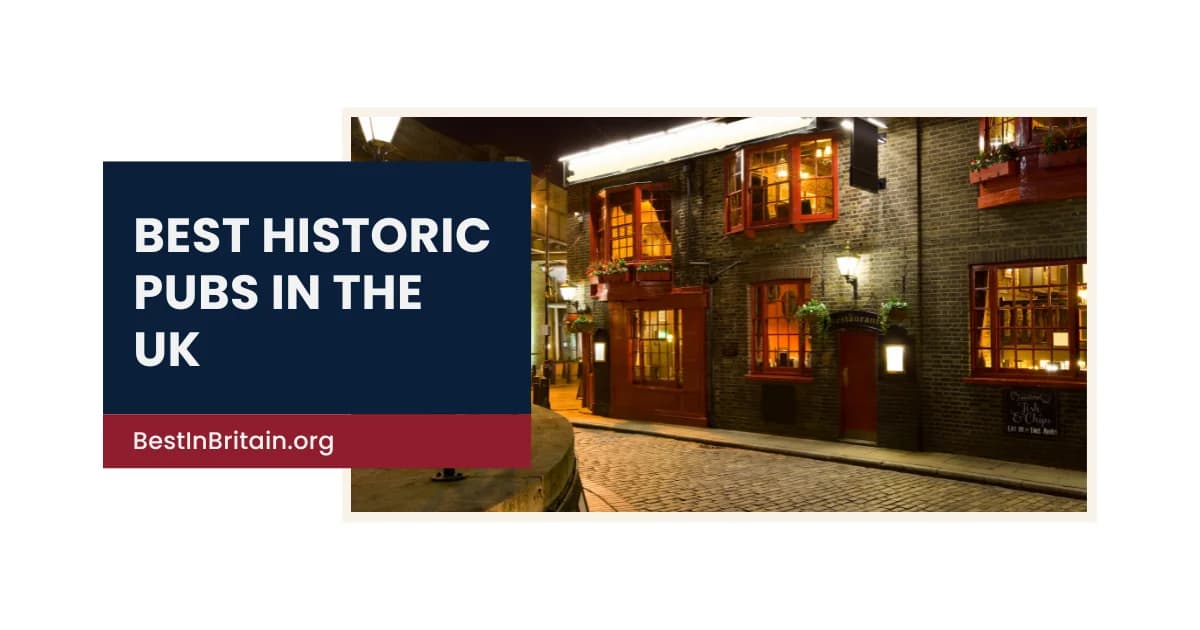
Britain's historic pubs preserve a form of social architecture that is disappearing surprisingly quickly. Their value does not rest only on age. A medieval coaching inn may retain an ancient courtyard but little of its later pub interior, while a late-Victorian drinking house can be historically exceptional because its tiled walls, etched-glass screens, snugs and bar fittings remain almost untouched.
The most revealing historic pubs show how people once used public houses. Separate rooms could divide customers by class, occupation, gender or the amount they were prepared to pay. Serving hatches allowed drinks to be passed into small compartments, while long counters, public bars and smoke rooms reflected changing ideas about privacy and sociability.
This guide focuses on pubs with genuine architectural, cultural or social significance. It is therefore different from a general list of traditional pubs. Atmosphere and beer still matter, but the central question is whether the building, interior or documented history helps visitors understand the development of the British public house.
We have avoided confidently repeating disputed claims about the “oldest pub in Britain”. Building age, licensing history, continuous use and the age of surviving interiors are separate questions, and the evidence is rarely simple.
Opening hours, ownership and food arrangements change regularly. Check directly before making a special journey, and remember that these are working pubs rather than museums.
How we selected the best historic pubs in the UK
Our editorial assessment considered:
- Surviving historic interior: Original or early bar counters, partitions, snugs, tilework, furniture, fireplaces and room layouts.
- Architectural importance: Buildings that represent coaching-inn, Victorian, Edwardian, Arts and Crafts or interwar pub design.
- Documented social history: Connections with travel, industry, journalism, politics, music or local community life.
- Integrity: Pubs whose historic character has not been overwhelmed by modern remodelling.
- Continued use: Buildings that remain recognisable public houses rather than heritage attractions with token bar service.
- Interpretive value: Places where the development of British pub culture can still be read in the architecture.
- Geographical range: Strong examples across England, Scotland, Wales and Northern Ireland.
CAMRA's National Inventory of Historic Pub Interiors was an important reference point. Its highest-rated pubs retain layouts or fittings of outstanding historic importance, but our selection also considers wider architectural and cultural significance.
Historic pubs in London
1. The George Inn, Southwark
Location: Borough High Street, Southwark
Historic interest: Surviving galleried coaching inn
Best for: Understanding how travellers entered and left historic London
The George is the last surviving galleried coaching inn in London. Hidden within a courtyard off Borough High Street, it preserves the physical form of a type of establishment that once lined the roads south of the Thames.
The present structures date largely from the late 17th century, following fires that destroyed earlier buildings. External galleries run above the courtyard, recalling the arrangement of rooms and circulation used by travellers, performers and staff.
Its location is crucial. Southwark stood outside the historic jurisdiction of the City and developed a dense concentration of inns, theatres and entertainment venues. Coaches departed from the area, while travellers waited before continuing across London Bridge.
Why it stands out:
The George preserves not just an old room but the courtyard, galleries and spatial organisation of a working coaching inn.
Good to know:
The courtyard becomes extremely busy in warm weather. Visit early on a weekday and explore the internal rooms rather than stopping at the first outside table.
2. The Princess Louise, Holborn
Location: High Holborn, London
Historic interest: Restored late-Victorian interior with compartments and etched glass
Best for: Experiencing the divided social layout of a Victorian pub
The Princess Louise contains one of London's most elaborate surviving Victorian pub interiors. Glazed tiles, engraved mirrors, decorative ceilings, polished wood and etched-glass partitions create a series of enclosed drinking spaces around the central bar.
The compartments demonstrate how public houses were once carefully divided. Customers could drink with greater privacy, and different rooms often carried distinct social expectations.
Restoration returned much of the interior to its compartmentalised form rather than opening the ground floor into one large modern space.
Why it stands out:
Few pubs explain the social organisation of Victorian drinking so clearly through their surviving layout.
Good to know:
The pub belongs to Samuel Smith, so the drinks range and house policies differ from many London pubs. Check current payment arrangements.
3. The Black Friar, Blackfriars
Location: Queen Victoria Street, London
Historic interest: Early-20th-century Arts and Crafts and Art Nouveau interior
Best for: One of Britain's most unusual decorative pub schemes
The Black Friar occupies a narrow triangular building near Blackfriars station. A sculpted friar on the exterior introduces an interior filled with mosaics, relief panels, coloured marble, bronze details and humorous monastic imagery.
The pub was remodelled during the early 20th century, when artists and designers transformed the rear room into an unusually complete decorative environment. Curved surfaces and inscriptions make it feel closer to a small secular chapel than an ordinary bar.
The building's compact shape encouraged creative use of every wall and corner.
Why it stands out:
The Black Friar represents a rare moment when Arts and Crafts design, commercial hospitality and playful historical imagery came together in one pub.
Good to know:
The interior is small and often crowded after work. A daytime visit provides the best opportunity to examine the decoration.
4. The Prince Alfred, Maida Vale
Location: Formosa Street, London
Historic interest: Rare surviving snob screens and compartmentalised bar
Best for: Seeing one of London's most intact high-Victorian pub interiors
The Prince Alfred retains a remarkable sequence of wooden and etched-glass partitions dividing the bar into separate compartments. Customers still pass through narrow openings between sections, making the historic layout impossible to ignore.
The so-called snob screens and divisions once offered privacy and helped separate different groups of drinkers. Decorative glass, tilework and the bar counter survive with unusual completeness.
The pub's Grade II* listing reflects the rarity and quality of the interior rather than the age of the building alone.
Why it stands out:
The Prince Alfred is one of the clearest surviving examples of how a prosperous Victorian London pub controlled movement and privacy.
Good to know:
The narrow compartments are part of the heritage but can feel awkward at busy times. Avoid blocking the small openings between bars.
5. The Salisbury, Harringay
Location: Green Lanes, Harringay
Historic interest: Grand late-Victorian suburban pub interior
Best for: Decorative glass, mirrors and the scale of a metropolitan drinking palace
The Salisbury was built to serve a rapidly expanding north London suburb. Its large corner position and richly decorated interior demonstrate the ambition invested in pubs as new neighbourhoods developed around tram and rail routes.
Mirrors, etched glass, mahogany, decorative ceilings and surviving divisions give the pub a sense of late-Victorian confidence. Unlike smaller central pubs, the building was conceived as a substantial social institution for its district.
Why it stands out:
The Salisbury shows that highly elaborate pub architecture was not limited to the West End or City of London.
Good to know:
The pub remains busy with local customers and events. Visit during a quieter afternoon to see the historic details properly.
6. Ye Olde Cheshire Cheese, Fleet Street
Location: Wine Office Court, Fleet Street
Historic interest: Rebuilt after the Great Fire with cellars and multiple rooms
Best for: The enclosed atmosphere of historic Fleet Street
Ye Olde Cheshire Cheese was rebuilt shortly after the Great Fire of London. The pub developed through a sequence of rooms, stairs, passages and cellar spaces behind Fleet Street.
Its literary and journalistic associations are frequently repeated, although some stories have acquired more certainty through repetition than the documentary evidence supports. The building itself is the stronger historical experience.
Dark panelling, low ceilings and separate rooms preserve the feeling of a pub serving distinct groups within London's former newspaper district.
Why it stands out:
The layout captures the dense, enclosed urban character of old Fleet Street more effectively than a reconstructed historical attraction could.
Good to know:
Explore beyond the main entrance bar. Access to lower rooms can depend on current operations and private bookings.
Historic pubs in southern and central England
7. The Fleece Inn, Bretforton, Worcestershire
Location: Bretforton, near Evesham
Historic interest: Medieval farmhouse adapted into a village pub
Best for: Vernacular architecture and living folk tradition
The Fleece began as a timber-framed farmhouse and became licensed as a pub during the 19th century. It is now owned by the National Trust but continues to operate as a genuine village inn.
Low ceilings, settles, flagstones, fireplaces and domestic proportions distinguish it from grand urban pubs. The building demonstrates how ordinary houses and farmsteads could evolve into public drinking spaces.
Folk music, Morris dancing and seasonal customs keep the pub's social history active rather than merely interpreted.
Why it stands out:
The Fleece combines an exceptionally atmospheric vernacular building with traditions still practised by the surrounding community.
Good to know:
Popular events transform the atmosphere and can fill every room. Book meals and check the programme before travelling.
8. The King's Head, Aylesbury
Location: Market Square, Aylesbury
Historic interest: Large medieval coaching-inn complex
Best for: Courtyard architecture and market-town travel history
The King's Head is one of England's most complete surviving coaching-inn complexes. Its buildings developed around a courtyard where travellers, horses, goods and staff could be managed within a protected space.
Timber framing, gateways, internal rooms and later fittings reveal several phases of use. The inn's scale reflects Aylesbury's importance as a market and transport centre.
The pub remains operational, allowing visitors to experience the building in a form close to its historic social purpose.
Why it stands out:
Few working inns retain such a legible relationship between public rooms, gateway and coaching courtyard.
Good to know:
Take time to examine the courtyard and external elevations. The historic interest is much broader than the main bar.
9. The Square and Compass, Worth Matravers, Dorset
Location: Worth Matravers, Isle of Purbeck
Historic interest: Rarely altered rural alehouse arrangement
Best for: A simple historic drinking space rather than a polished heritage interior
The Square and Compass occupies stone buildings above the Dorset coast and retains an arrangement closer to an old alehouse than a conventional pub.
Drinks are served through a hatch, the rooms remain simple and much of the seating is outside. Local cider, limited food and a small fossil collection connect the pub closely with its region.
Its importance lies partly in what has not happened. It has resisted wholesale conversion into a restaurant, boutique inn or consciously styled destination.
Why it stands out:
The Square and Compass preserves the directness and informality of a rural drinking house with very little architectural theatre.
Good to know:
Food is limited and the village has restricted space. Check current hours and approach respectfully.
10. The Bell Inn, Aldworth, Berkshire
Location: Aldworth, Berkshire
Historic interest: Long family stewardship and largely unspoilt village rooms
Best for: A quiet example of the traditional rural local
The Bell is a small village pub whose historical value comes from continuity, modest scale and a lack of aggressive remodelling.
Simple rooms, settles, fireplaces and old fittings create an atmosphere accumulated through use rather than installed as decoration. Long family stewardship helped protect the pub from the repeated redesigns experienced by many rural houses.
Why it stands out:
The Bell demonstrates that historic importance can reside in ordinary, carefully preserved spaces rather than elaborate architecture.
Good to know:
Opening and food service may be limited. Confirm directly before travelling from a distance.
11. The Blue Anchor, Helston, Cornwall
Location: Coinagehall Street, Helston
Historic interest: Historic brewing pub with surviving multi-room character
Best for: The connection between brewing and public-house history
The Blue Anchor is closely identified with Spingo ales brewed on the premises. Brewing, drinking and hospitality remain connected within the same historic business.
Low rooms, dark timber and separate drinking areas give the pub an old Cornish inn atmosphere, but the continuing beer tradition is more important than appearance alone.
The strength and character of Spingo vary between styles, offering a drinks experience unavailable in ordinary tied or managed pubs.
Why it stands out:
The Blue Anchor preserves the historic relationship between a public house and the beer made within it.
Good to know:
Some beers are strong. Ask for guidance and plan transport carefully.
12. The Royal Standard of England, Forty Green, Buckinghamshire
Location: Forty Green, near Beaconsfield
Historic interest: Timber-framed rural inn with accumulated interiors
Best for: Old-English inn atmosphere and historic building fabric
The Royal Standard of England occupies a timber-framed building reached by a narrow rural lane. Low beams, fireplaces, worn floors, old furniture and collections of objects produce an intensely historic atmosphere.
Some claims associated with the pub's age and national status are difficult to verify fully, but the building contains genuinely old fabric and has operated as an inn across a long period.
It has also appeared in film and television, reinforcing the visual image of the archetypal English tavern.
Why it stands out:
The Royal Standard offers one of the most immersive historic-inn interiors in southern England.
Good to know:
Its popularity and media associations can make it busy. Focus on the surviving building rather than repeating every age claim as fact.
Historic pubs in the Midlands and eastern England
13. Ye Olde Trip to Jerusalem, Nottingham
Location: Beneath Nottingham Castle
Historic interest: Pub rooms integrated into sandstone caves
Best for: The relationship between city geology and public-house development
Ye Olde Trip to Jerusalem stands against the sandstone beneath Nottingham Castle, with rooms and cellars cut into the rock.
Its claim to be one of England's oldest inns is famous but difficult to prove in the simple form often advertised. The physical relationship with the castle rock is more convincing and historically valuable.
The caves illustrate how Nottingham's soft sandstone was used for storage, brewing and urban occupation across centuries.
Why it stands out:
The pub is inseparable from the cave landscape beneath Nottingham, giving it a historical character no conventional timber inn can replicate.
Good to know:
Explore the cave-linked rooms and do not reduce the visit to a photograph of the exterior sign.
14. The Bartons Arms, Birmingham
Location: Aston, Birmingham
Historic interest: Outstanding Edwardian tilework and public-house architecture
Best for: One of the finest surviving urban pub interiors in Britain
The Bartons Arms was built at the beginning of the 20th century and contains an exceptional sequence of glazed tiles, mirrors, woodwork, staircases and separate rooms.
The building reflects the wealth and confidence of industrial Birmingham, when breweries invested heavily in visually impressive public houses. Its position in Aston also makes it an important survivor beyond the city's central commercial district.
The pub's established Thai kitchen adds a contemporary Birmingham identity without erasing the historic plan.
Why it stands out:
The Bartons Arms is both an architectural monument and a living example of how a heritage pub can adapt successfully.
Good to know:
Check current opening and kitchen days. The full interior deserves more than a quick meal stop.
15. The Beacon Hotel, Sedgley, West Midlands
Location: Sedgley, Dudley
Historic interest: Traditional multi-room brewery pub
Best for: Rare pub layout and a continuing brewing identity
The Beacon Hotel is associated with Sarah Hughes Brewery and retains an old-fashioned sequence of rooms served from a central bar.
Plain fittings, separate spaces and an absence of unnecessary modern styling make the pub especially important. Its historical value comes from the survival of an everyday regional pub layout rather than decorative grandeur.
The brewery's strong dark mild is central to the experience and connects the building with Black Country brewing history.
Why it stands out:
The Beacon preserves a form of working multi-room pub that has been opened out or lost almost everywhere else.
Good to know:
The traditional layout can initially feel confusing. Ask at the appropriate hatch or bar and treat stronger beers with care.
16. The Vine, West Bromwich
Location: Roebuck Street, West Bromwich
Historic interest: Traditional Black Country rooms with a long-established Punjabi kitchen
Best for: Understanding how pub culture evolves through local communities
The Vine retains the room structure and bar-led character of a traditional West Midlands pub while being celebrated for its Punjabi grills and curries.
This combination represents an important regional development. Punjabi pubs emerged through the social and entrepreneurial life of British Asian communities, particularly around the Black Country and Birmingham.
The Vine therefore belongs in a historic-pub guide not because it has resisted change, but because its adaptation has become part of the area's pub history.
Why it stands out:
It demonstrates that cultural evolution can strengthen a traditional pub rather than erase its identity.
Good to know:
Food is a major attraction and tables become busy. Check current service arrangements.
17. The Coopers Tavern, Burton upon Trent
Location: Cross Street, Burton upon Trent
Historic interest: Domestic rooms and beer served directly from casks
Best for: Brewing-town history and an intimate parlour-pub layout
The Coopers Tavern occupies a former house close to Burton's historic brewing district. Rather than a large open bar, it contains a sequence of domestic-scale rooms.
Beer service directly from casks behind the bar reinforces the relationship with Burton's brewing heritage. The arrangement feels more like entering a private house gradually adapted for public use than a purpose-built drinking hall.
Why it stands out:
The Coopers Tavern combines domestic architecture, traditional service and the identity of Britain's most famous brewing town.
Good to know:
The rooms are small and popular. Large groups can overwhelm the atmosphere.
Historic pubs in northern England
18. The Philharmonic Dining Rooms, Liverpool
Location: Hope Street, Liverpool
Historic interest: Grade I-listed Victorian drinking palace
Best for: The decorative peak of British pub architecture
The Philharmonic Dining Rooms is among the most architecturally important pubs in Britain. Built during Liverpool's late-Victorian commercial expansion, it contains mosaic floors, carved wood, stained glass, elaborate plasterwork and richly fitted rooms.
The arrangement includes a grand central bar and smaller rooms that preserve the hierarchy and theatricality of the period. Even utilitarian spaces received exceptional decorative attention.
Its location opposite the Philharmonic Hall connects the pub with the cultural identity of Hope Street.
Why it stands out:
The Phil represents the pub as civic showpiece, constructed with a level of craftsmanship normally associated with banks, hotels or public buildings.
Good to know:
Visit outside concert and weekend peaks. The building deserves a slow circuit, not only a drink in the first available space.
19. Whitelock's Ale House, Leeds
Location: Turk's Head Yard, Leeds
Historic interest: Late-Victorian and Edwardian interior in a hidden city-centre yard
Best for: Leeds drinking history and an intimate urban interior
Whitelock's occupies a narrow site hidden off Briggate. Decorative tiles, mirrors, stained glass, polished wood and a long bar create one of northern England's most atmospheric historic interiors.
The pub developed from a much older business, but the surviving decorative scheme reflects later investment during Leeds's industrial and commercial growth.
Its enclosed yard setting creates a strong contrast with the busy shopping streets only a few steps away.
Why it stands out:
Whitelock's combines an important historic interior with a location that preserves the hidden-yard character of old central Leeds.
Good to know:
It becomes extremely busy at lunch and after work. Early weekday visits suit architectural exploration.
20. The Marble Arch Inn, Manchester
Location: Rochdale Road, Manchester
Historic interest: Sloping mosaic floor and glazed Victorian interior
Best for: Historic decoration combined with independent brewing
The Marble Arch is famous for its floor, which slopes noticeably through the long room. The mosaic surface, decorative wall tiles and high glazed ceiling create an interior full of visual movement.
The pub also developed a strong association with modern independent beer through Marble Brewery. This allows it to connect Manchester's historic pub-building tradition with the city's later brewing revival.
Why it stands out:
The Marble Arch is architecturally memorable without feeling preserved in isolation from contemporary beer culture.
Good to know:
The pub sits outside the busiest central circuit. Check current food service before making a dedicated trip.
21. The Blue Bell, York
Location: Fossgate, York
Historic interest: Exceptionally intact Edwardian two-room interior
Best for: A small, highly preserved city pub
The Blue Bell is a compact pub with two principal rooms, historic counters, partitions, fixed seating and decorative glass.
Its small size is central to its significance. The pub was never transformed into a large open drinking space, allowing the intimacy and social arrangement of an early-20th-century local to survive.
The building has faced periods of uncertainty, making continued protection and sensitive operation especially important.
Why it stands out:
The Blue Bell is one of the clearest surviving examples of a small Edwardian city pub interior.
Good to know:
Space is extremely limited. It is unsuitable for large groups and works best for a quiet drink.
Historic pubs in Scotland
22. Café Royal, Edinburgh
Location: West Register Street, Edinburgh
Historic interest: Ornate Victorian bar and ceramic artworks
Best for: A grand city interior with strong food and drink continuity
Café Royal occupies a richly decorated room close to Princes Street. Stained glass, mirrors, ornate plasterwork, ceramic panels and dark wood create one of Scotland's finest surviving city-bar interiors.
The ceramic artworks depict inventors and industrial figures, reflecting Victorian faith in engineering and progress. Oysters, seafood and beer have long been part of the venue's public identity.
Why it stands out:
Café Royal combines exceptional decoration with the continuing bustle of a working Edinburgh bar.
Good to know:
Festival periods and evenings are very busy. Visit early to examine the decorative panels.
23. The Laurieston Bar, Glasgow
Location: Bridge Street, Glasgow
Historic interest: Intact mid-20th-century interior and family stewardship
Best for: A rare post-war urban pub rather than Victorian grandeur
The Laurieston demonstrates that historic pub interiors do not have to be ancient or ornate. Its counters, fixed seating, signage, colour scheme and overall arrangement preserve the character of a mid-20th-century Glasgow bar.
The pub's long family stewardship helped prevent fashionable remodelling. What might once have seemed ordinary has become rare because so many comparable interiors were stripped out.
Why it stands out:
The Laurieston preserves the social and visual character of a working-class post-war city pub with remarkable integrity.
Good to know:
This is a genuine local, not a heritage installation. Visit respectfully and avoid treating regular customers as background scenery.
Historic pubs in Wales
24. The Golden Lion, Llangynhafal, Denbighshire
Location: Llangynhafal, Vale of Clwyd
Historic interest: Traditional rural layout and community continuity
Best for: A historic Welsh village-pub experience
The Golden Lion sits beneath the Clwydian hills and retains the scale and atmosphere of a rural Welsh inn. Low rooms, fireplaces and traditional fittings connect it with the surrounding farming and walking community.
Its historical value is less about decorative display than continuity of use. It remains a place where food, drink and village social life overlap naturally.
Why it stands out:
The Golden Lion represents the modest but culturally important village pub, a form of heritage easily lost when rural buildings become private homes or restaurants.
Good to know:
Check opening and kitchen hours, particularly outside weekends and the main walking season.
Historic pubs in Northern Ireland
25. The Crown Liquor Saloon, Belfast
Location: Great Victoria Street, Belfast
Historic interest: Ornate late-Victorian gin-palace interior
Best for: One of the UK's most complete historic pub interiors
The Crown Liquor Saloon is the outstanding historic pub interior in Northern Ireland. Coloured glass, patterned tilework, carved wood, mirrors, decorative ceilings and a sequence of private snugs survive with extraordinary richness.
The snugs include doors, bells and screens that allowed customers to drink with privacy. The design reflects the visual ambition of Belfast during its late-19th-century industrial growth.
The building is owned by the National Trust and remains in commercial use, balancing heritage protection with everyday pub life.
Why it stands out:
The Crown is a near-complete lesson in Victorian pub design, social division and decorative craftsmanship.
Good to know:
The snugs are highly sought after. Visit close to opening and avoid obstructing the narrow circulation routes while taking photographs.
Other historic pubs worth visiting
A list of 25 cannot include every significant pub interior or historic inn. Further strong choices include:
- The Argyll Arms in Soho, London
- The Victoria in Paddington, London
- The Cittie of Yorke in Holborn, London
- The Lamb in Bloomsbury, London
- The Grenadier in Belgravia, London
- The Palm Tree in Mile End, London
- The Red Lion in St James's, London
- The Olde Mitre in Holborn, London
- The Harrow at Steep, Hampshire
- The Royal Oak at Wantage, Oxfordshire
- The Old Green Tree in Bath
- The Star Inn at Bath
- The Old Joint Stock in Birmingham
- The Great Western in Wolverhampton
- The Old Swan in Netherton
- The Seven Stars in Rugby
- The Nutshell in Bury St Edmunds
- The Fat Cat in Sheffield
- The Victoria Hotel in Beeston
- The Grove Inn in Huddersfield
- The Victoria in Durham
- The Bridge Hotel in Newcastle
- The Free Trade Inn in Newcastle
- The Roscoe Head in Liverpool
- The Vines in Liverpool
- The Lion Tavern in Liverpool
- The Briton's Protection in Manchester
- The Peveril of the Peak in Manchester
- The City Arms in Cardiff
- The Blue Bell in Cardiff
- The Cross Inn in Penally
- Tafarn Sinc in Pembrokeshire
- The Guildford Arms in Edinburgh
- The Oxford Bar in Edinburgh
- The Scotia Bar in Glasgow
- The Steps Bar in Glasgow
- Kelly's Cellars in Belfast
- The Duke of York in Belfast
- The Garrick in Belfast
- The Crosskeys Inn near Toome
Best historic pubs for different interests
Best overall historic interior
The Crown Liquor Saloon, Philharmonic Dining Rooms, Princess Louise and Bartons Arms provide the strongest complete decorative experiences.
Best coaching inn
The George Inn and King's Head at Aylesbury preserve the most revealing coaching-era layouts.
Best Victorian pub
The Prince Alfred, Princess Louise, Whitelock's and Café Royal show different expressions of Victorian pub design.
Best simple rural interior
The Bell at Aldworth and Square and Compass demonstrate the value of plain, minimally altered pub spaces.
Best historic brewery pub
The Blue Anchor and Beacon Hotel maintain unusually strong links between the pub and its associated beer.
Best 20th-century pub interior
The Laurieston Bar is the standout choice for visitors interested in post-war rather than Victorian pub design.
Best for social-history interpretation
The Prince Alfred's compartments, Crown Liquor Saloon's snugs and Princess Louise's divisions reveal how pubs once separated customers and controlled privacy.
How to read a historic pub interior
Snug
A small enclosed compartment providing privacy. Snugs were often used by customers who wanted to drink away from the public bar.
Public bar
Historically the more basic and often cheaper drinking room, with simpler fittings than the lounge or saloon.
Saloon or lounge
A more comfortable room where drinks could cost slightly more. Furnishings and service were often more elaborate.
Snob screen
A movable or fixed glass screen positioned above a bar counter or partition. It allowed customers privacy while still enabling service.
Jug and bottle department
A small off-sales area where customers purchased beer or spirits to take away without entering the main rooms.
Drinking lobby
A corridor or space where customers could stand and receive drinks through a hatch.
Bar back
The shelving, mirrors and decorative structure behind the counter. Original bar backs are frequently lost during refurbishment.
Fixed seating
Benches built into the walls. Historic seating can reveal the original shape and use of a room.
Ceramic exterior
Some Victorian and Edwardian pubs used glazed tiles or faience outside because it was durable, easy to clean and visually striking.
Why historic pub interiors disappear
Historic pubs are vulnerable even when the building remains open.
Common losses include:
- Removing partitions to create one open room
- Replacing original counters and bar backs
- Stripping out fixed seating
- Covering old floors
- Removing etched glass
- Converting drinking rooms into dining areas
- Installing standardised chain furniture
- Blocking old serving hatches
- Dividing buildings into flats
- Closing the pub and changing its use
- Neglecting roofs, drainage and external fabric
Listing can protect significant architecture, but it does not guarantee commercial survival. Pubs need sensitive owners, viable trade and customers who value the building as a public house.
How to visit a heritage pub respectfully
- Buy a drink or meal rather than entering only for photographs.
- Ask before photographing staff or customers.
- Avoid blocking doors, hatches and narrow compartments.
- Do not move historic furniture.
- Keep groups small in compact pubs.
- Visit outside peak service where possible.
- Read about the interior before arrival.
- Distinguish documented history from marketing folklore.
- Never carve, scratch or attach anything to the building.
- Support independent and community operators.
- Use public transport or a designated driver.
- Remember that regular customers are not part of the exhibit.
A quiet daytime visit is often better for studying architecture, but the pub should also be experienced in use. Empty rooms show fittings; active rooms show why those fittings existed.
Frequently asked questions
What is CAMRA's National Inventory of Historic Pub Interiors?
It is a register of pubs whose interiors retain nationally significant historic layouts or fittings. CAMRA currently uses Three Star, Two Star and One Star categories to describe different levels of importance and survival.
Is a listed pub automatically on the National Inventory?
No. Statutory listing protects buildings of architectural or historic interest, while CAMRA's inventory specifically evaluates the importance and survival of pub interiors.
What is the oldest pub in Britain?
There is no universally accepted answer. Claims depend on whether age refers to the building, licence, inn use or continuous trading. Many advertised dates are based partly on tradition rather than complete documentary evidence.
Are historic pubs expensive?
Not necessarily. Some are ordinary locals with standard drink prices, while central-city landmarks and food-led inns can be more expensive.
Can children enter historic pubs?
Policies vary by licence, room and time. Children are often welcome for meals but may be restricted from particular bars or evening sessions.
Can you photograph historic pub interiors?
Usually, provided photography is discreet and does not include people without permission. Some pubs restrict photography during busy periods or private events.
Why do historic pubs have several small rooms?
Separate rooms reflected social divisions, privacy, different prices and changing expectations about respectable drinking. Many were later removed to reduce staffing and increase capacity.
Do heritage pubs still serve real ale?
Many do, but historic significance does not guarantee a particular drinks range. Check current beer information directly.
Final thoughts
Historic pubs matter because they preserve a form of architecture designed around ordinary social life.
The Crown Liquor Saloon and Philharmonic Dining Rooms show the extraordinary decorative ambition once invested in public houses. The Princess Louise and Prince Alfred reveal how drinkers were separated into compartments, while the Bell at Aldworth and Square and Compass preserve simpler rural traditions.
The most important lesson is that age alone is not enough. A pub can occupy a medieval building and retain little historic pub character, while a modest 1960s interior may be rare because almost every comparable example has disappeared.
Visit carefully, question the legends and support the bar. The best way to protect a historic pub is to understand its significance while allowing it to remain a living public house.
Related articles
Related guides
Bars and Pubs
30 best traditional pubs in the UK
Discover 30 of the best traditional pubs in the UK, from historic London taverns and rural coaching inns to community-owned Highland pubs and celebrated locals across Britain.
Updated 25 June 2026
Bars and Pubs
25 best gastropubs in the UK
Discover 25 of the best gastropubs in the UK, from ambitious rural inns and Michelin-recognised dining pubs to brilliant neighbourhood locals serving exceptional seasonal food.
Updated 19 June 2026

Bars and Pubs
Best karaoke bars in Edinburgh
A practical guide to Edinburgh karaoke venues, covering private rooms, public singalongs, group capacities, current prices, age rules and party-planning details.
Updated 2 August 2026
Bars and Pubs
Best nightclubs in Edinburgh
A practical guide to Edinburgh nightclubs and late-night music venues, covering electronic music, student nights, live DJs, tickets, age rules and accessibility.
Updated 2 August 2026
Bars and Pubs
Top Bars in Edinburgh for Excellent Drinks
A researched guide to Edinburgh bars serving exceptional cocktails, Scottish whisky, local beer and carefully selected spirits across the Old Town, New Town, West End and Leith.
Updated 1 August 2026
Bars and Pubs
Top Sports Bars in London to Watch the Game
A practical guide to London sports bars, comparing screen coverage, sound, booking terms, age restrictions, late opening, food, accessibility and matchday atmosphere.
Updated 22 July 2026
Know a business we should consider?
Send us the details and our editorial team will review whether it fits a future guide.
Submit businessWriter profile
Emily Smith
Hospitality and local culture desk researcher
Emily researches and compiles editorial guides for restaurants, bars, cafes, event venues, hotels, galleries, and city leisure.
Editorial Trust Standard
Independent ReviewIndependent Research
Featured rankings are editorially determined. Commercial partner listings are strictly labeled as Sponsored or Featured.
Public Register Audit
Listings are cross-checked against public regulatory registries, Companies House filings, and published fee schedules.