
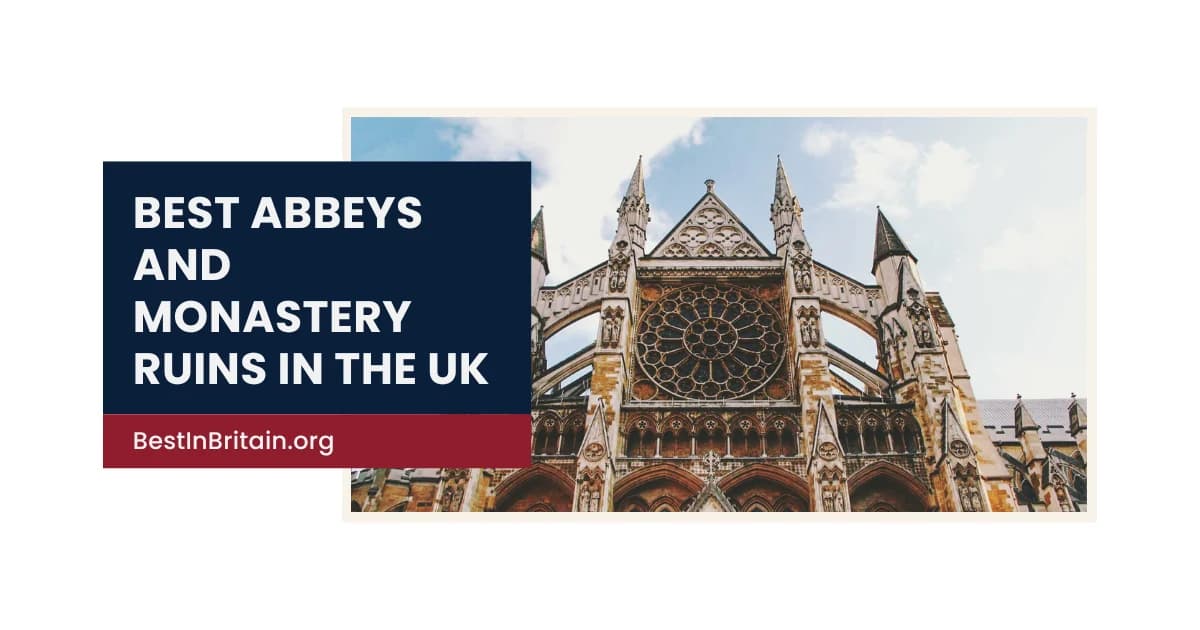
Britain's ruined abbeys and monasteries are among its most evocative historic places. Roofless churches still rise above river valleys, coastal cliffs and quiet villages, while fragments of cloisters, chapter houses, kitchens and dormitories reveal how entire religious communities once lived and worked.
These sites are often described as romantic ruins, but their histories are more complex than their peaceful appearance suggests. Medieval monasteries were centres of worship, farming, education, hospitality, manuscript production and political influence. Many accumulated substantial wealth and controlled large estates before war, reform and the dissolution of religious houses brought monastic life to an end.
The finest ruins preserve more than a dramatic silhouette. They help visitors understand the daily organisation of a monastery, the differences between religious orders and the role these institutions played within their surrounding landscapes.
This guide brings together 20 of the best abbeys and monastery ruins in the UK, spanning England, Scotland, Wales and Northern Ireland. Access can change because exposed masonry requires continual conservation, so check the official website before travelling.
How we selected the best abbey and monastery ruins
Our editorial selection considered:
- Surviving architecture: The scale, quality and legibility of the remaining church and monastic buildings.
- Historic importance: Connections with religious orders, rulers, conflict, pilgrimage and the dissolution of monasteries.
- Landscape and atmosphere: Settings that remain integral to understanding the site.
- Visitor interpretation: Useful displays, plans, museums or guide material that explain monastic life.
- Regional variety: A spread across all four nations of the UK.
- Overall experience: Sites substantial enough to justify a dedicated journey or form the centre of a wider day out.
Abbey and monastery ruins in England
1. Fountains Abbey, North Yorkshire
Location: Ripon, North Yorkshire
Best for: Monumental ruins, landscaped gardens and a full-day visit
Allow: A full day
Fountains Abbey is the most complete and visually overwhelming monastic ruin in Britain. Founded by a group of Benedictine monks in 1132 and soon absorbed into the Cistercian order, it developed into one of medieval England's wealthiest religious houses.
The surviving church, cellarium, cloister ranges and domestic buildings reveal the organisation of the community on an exceptional scale. The vast nave and tower dominate the ruins, while the vaulted cellarium gives visitors a rare opportunity to walk through a substantial surviving monastic interior.
The abbey later became part of the designed landscape of Studley Royal. Formal water gardens, woodland paths, follies and carefully framed views turned the medieval remains into a central feature of an 18th-century estate.
Why it stands out:
No other UK site combines such extensive monastic remains with a landscape of comparable ambition. It is both an archaeological site and one of Britain's great designed gardens.
Good to know:
The estate is extensive and involves significant walking. Begin with the abbey ruins before continuing through the water garden rather than trying to rush the entire circuit.
2. Rievaulx Abbey, North Yorkshire
Location: Helmsley, North Yorkshire
Best for: Cistercian architecture and a secluded valley setting
Allow: Two to four hours
Rievaulx Abbey was founded in 1132 as the first Cistercian abbey in northern England. It quickly became an influential centre of monasticism and reached its height under Abbot Aelred during the 12th century.
The tall presbytery walls, arches and transepts retain an elegance that contrasts with the enclosing hills. The site plan remains readable, allowing visitors to trace the church, cloister, chapter house, infirmary and working areas of the community.
Its valley location was not chosen for scenery alone. Isolation, water supply and access to land all suited Cistercian ideals and the practical needs of a large monastery.
Why it stands out:
Rievaulx combines graceful architecture with one of England's most atmospheric monastic landscapes. The ruins remain substantial enough to communicate the abbey's former power.
Good to know:
Rievaulx Terrace above the valley provides a separate landscaped viewpoint managed by the National Trust. It is not part of standard abbey admission.
3. Whitby Abbey, North Yorkshire
Location: Whitby, North Yorkshire
Best for: Coastal drama, early Christian history and literary associations
Allow: Two to three hours
Whitby Abbey occupies a commanding cliff above the North Sea. The present Gothic ruins belong largely to the later Benedictine monastery, but religious life on the headland began much earlier with the double monastery led by St Hild in the seventh century.
The site is connected with the Synod of Whitby, an important moment in the development of the early English church. It is also associated with the poet Cædmon and, much later, with the atmosphere of Bram Stoker's Dracula.
The roofless church is striking from almost every angle, particularly when approached from the town by the 199 steps.
Why it stands out:
Whitby unites archaeology, coastal scenery and cultural memory. The ruins are inseparable from the sea, weather and skyline around them.
Good to know:
The headland is exposed and can feel significantly colder than the town below. The site can also be reached by road for visitors unable to manage the steps.
4. Glastonbury Abbey, Somerset
Location: Glastonbury, Somerset
Best for: Legend, pilgrimage and early medieval history
Allow: Two to three hours
Glastonbury Abbey was one of medieval England's most prestigious religious houses. Its history became intertwined with stories of early Christianity, Joseph of Arimathea and King Arthur, giving the abbey a reputation that extended far beyond its documented past.
The surviving ruins include sections of the great church, the Lady Chapel and the Abbot's Kitchen, one of the site's most complete medieval buildings. Interpretation helps visitors distinguish archaeological evidence from later legend.
The broad grounds create a calm green space within the town, with the Tor visible beyond.
Why it stands out:
Few abbeys demonstrate so clearly how history, pilgrimage and mythology can reinforce one another. Glastonbury's influence rests as much on the stories told about it as on its surviving masonry.
Good to know:
Allow time for the museum and interpretation. The site becomes more meaningful when the legendary claims are considered alongside the known history.
5. Battle Abbey, East Sussex
Location: Battle, East Sussex
Best for: The Norman Conquest and battlefield history
Allow: Half a day
Battle Abbey was founded by William the Conqueror on the site traditionally associated with his victory at the Battle of Hastings in 1066. The high altar of the abbey church was said to mark the place where King Harold fell.
Much of the abbey church has disappeared, but the gatehouse, precinct buildings and outlines of the monastery remain. The battlefield trail gives the site its wider significance, allowing visitors to consider the terrain and movement of the opposing armies.
This is not the most architecturally complete abbey on the list, but few ruins are connected with an event that changed Britain so decisively.
Why it stands out:
Battle Abbey turns a monastic visit into an exploration of conquest, memory and the political purpose of religious foundations.
Good to know:
The battlefield path can be muddy and uneven. The full experience involves much more walking than the abbey precinct alone.
6. Byland Abbey, North Yorkshire
Location: Coxwold, North Yorkshire
Best for: Early Gothic architecture and a quieter alternative to nearby abbeys
Allow: One to two hours
Byland Abbey was once one of the leading Cistercian houses in northern England. Although less complete than Fountains or Rievaulx, its west front and great rose window remain among the most beautiful surviving elements of English monastic architecture.
The abbey church influenced later Gothic design, and the floor preserves important medieval tiles. The open site makes the plan of the church and surrounding ranges easy to understand.
Byland is often much quieter than the better-known Yorkshire ruins, giving visitors time to study the masonry without large crowds.
Why it stands out:
The surviving west front demonstrates how architectural quality can remain evident even when much of a building has disappeared.
Good to know:
Facilities are limited compared with major paid attractions. Combine the visit with Rievaulx, Helmsley or the village of Coxwold.
7. Jervaulx Abbey, North Yorkshire
Location: Ripon, North Yorkshire
Best for: Peaceful ruins, wild planting and independent atmosphere
Allow: One to two hours
Jervaulx Abbey is a privately managed Cistercian ruin in the Yorkshire Dales. It lacks the towering church walls of Rievaulx, but the surviving foundations, arches and domestic spaces sit within gardens that have been allowed to soften naturally around the stone.
The abbey became known for sheep farming and dairy production, with a traditional association with the development of Wensleydale cheese. Its history reflects the economic as well as spiritual organisation of Cistercian monasteries.
The informal character makes Jervaulx feel less curated and more contemplative than many larger heritage sites.
Why it stands out:
Jervaulx is one of the most peaceful monastic ruins in England. Vegetation, fragmented masonry and the surrounding landscape create an unusually gentle atmosphere.
Good to know:
Access arrangements and payment methods can differ from major heritage organisations. Check the current visitor information before arriving.
8. Hailes Abbey, Gloucestershire
Location: Winchcombe, Gloucestershire
Best for: Pilgrimage history and museum interpretation
Allow: Two to three hours
Hailes Abbey was founded in the 13th century by Richard, Earl of Cornwall. It became a major destination after acquiring a relic said to contain the Holy Blood of Christ.
The church survives mainly at foundation level, but the cloister walks, chapter house and domestic ranges remain legible. The site's museum uses artefacts and modern interpretation to explain monastic routines, pilgrimage and the abbey's relationship with its patrons.
The nearby parish church contains medieval wall paintings and makes a valuable addition to the visit.
Why it stands out:
Hailes demonstrates that low ruins can still tell a rich story when archaeology and interpretation work together effectively.
Good to know:
Do not judge the site only by the height of the walls. The museum is essential to understanding what once stood here.
9. Netley Abbey, Hampshire
Location: Southampton, Hampshire
Best for: Free access, Gothic ruins and Romantic atmosphere
Allow: One to two hours
Netley Abbey contains some of the most complete Cistercian ruins in southern England. The church walls, chapter house, cloisters and later domestic alterations survive amid mature trees near Southampton Water.
After the dissolution, parts of the monastery were converted into a mansion. Its later decay attracted artists, writers and visitors who helped establish the Romantic taste for picturesque ruins.
The site is free to enter and remains particularly rewarding in quieter morning or evening light.
Why it stands out:
Netley preserves both monastic architecture and evidence of its transformation into a post-medieval residence. Its accessibility makes it one of England's best free abbey visits.
Good to know:
There is no large visitor centre. Bring your own background information or use the official guide material to interpret the different spaces.
10. St Augustine's Abbey, Kent
Location: Canterbury, Kent
Best for: The origins of Christianity in Anglo-Saxon England
Allow: One to two hours
St Augustine's Abbey was founded shortly after Augustine arrived in Kent in 597. It became a burial place for early archbishops and kings and formed part of the religious transformation of Anglo-Saxon England.
The ruins are less visually dramatic than Canterbury Cathedral, but their historical importance is exceptional. Archaeological remains show the development from early churches to a major medieval Benedictine abbey.
A museum displays objects recovered from the site and explains the relationship between the abbey, cathedral and early Christian kingdom of Kent.
Why it stands out:
This is one of the foundational places in English church history. Its value lies in archaeology and context rather than towering architecture.
Good to know:
Visit before or after Canterbury Cathedral to understand how the two institutions developed together.
Abbey and monastery ruins in Scotland
11. Melrose Abbey, Scottish Borders
Location: Melrose, Scottish Borders
Best for: Gothic sculpture, royal associations and a Borders itinerary
Allow: One to two hours
Melrose Abbey was founded by David I in 1136 as Scotland's first Cistercian monastery. Its position near the border exposed it repeatedly to warfare, and the surviving church largely reflects rebuilding after earlier destruction.
The ruins contain elaborate late-medieval carving, including saints, grotesques, plants and the celebrated bagpipe-playing pig. The heart of Robert the Bruce is traditionally associated with burial at the abbey.
Melrose is one of four great ruined abbeys in the Scottish Borders and can form the centre of a wider route through the region.
Why it stands out:
Melrose combines historical importance with some of Scotland's finest surviving Gothic stone carving.
Good to know:
Conservation work can restrict access to towers or parts of the ruins. Check current closures before travelling.
12. Jedburgh Abbey, Scottish Borders
Location: Jedburgh, Scottish Borders
Best for: Romanesque and early Gothic architecture
Allow: One to two hours
Jedburgh Abbey was founded for Augustinian canons in the 12th century. Built over several decades, its church preserves an unusual transition from rounded Romanesque arches to pointed Gothic forms.
The surviving nave, west front and tower give the site impressive vertical scale. The associated visitor interpretation explains the daily organisation of the abbey and its repeated exposure to warfare in the border region.
Its location within Jedburgh makes it easy to combine with the town's other historic attractions.
Why it stands out:
Jedburgh is one of the clearest places in Scotland to see architectural styles changing within a single medieval building.
Good to know:
Some elevated areas may close for conservation, but the main church remains substantial when viewed from ground level.
13. Dryburgh Abbey, Scottish Borders
Location: St Boswells, Scottish Borders
Best for: Seclusion, riverside scenery and literary history
Allow: One to two hours
Dryburgh Abbey occupies a quiet loop of the River Tweed surrounded by woodland. Founded for Premonstratensian canons, it was never as wealthy as Melrose or Kelso but retains a particularly contemplative character.
Parts of the chapter house, transepts and domestic ranges survive, with later burials adding another layer of history. Sir Walter Scott and Field Marshal Earl Haig are among those buried within the grounds.
The estate-like setting and mature trees contributed to Dryburgh's popularity as a Romantic ruin.
Why it stands out:
Dryburgh offers the most tranquil experience among the great Borders abbeys. Its atmosphere is as important as its architecture.
Good to know:
The site is less convenient without a car than Melrose or Jedburgh. Combine it with nearby Scott's View or Abbotsford.
14. Kelso Abbey, Scottish Borders
Location: Kelso, Scottish Borders
Best for: Monumental fragments and early Scottish monastic history
Allow: Around one hour
Kelso Abbey was founded by Tironensian monks invited by David I and became one of medieval Scotland's wealthiest religious houses. Its proximity to Roxburgh Castle placed it close to royal power but also made it vulnerable during periods of conflict.
Only part of the great church survives, yet the massive western crossing and tower convey the building's former scale. The compact site can be explored quickly, but the architecture deserves close attention.
Why it stands out:
Kelso proves that a fragment can still communicate extraordinary power. Its surviving masonry is among the boldest Romanesque work in Scotland.
Good to know:
The ruin is smaller than Melrose or Jedburgh and is best included as part of a Borders abbey route.
Abbey and monastery ruins in Wales
15. Tintern Abbey, Monmouthshire
Location: Tintern, Monmouthshire
Best for: Gothic architecture, Romantic art and the Wye Valley
Allow: Two to three hours
Tintern Abbey was founded in 1131 as the first Cistercian monastery in Wales. Its great Gothic church, built during the 13th and 14th centuries, remains one of Britain's most recognisable roofless buildings.
The tall windows and slender piers inspired artists, writers and travellers during the rise of Picturesque tourism. William Wordsworth and J. M. W. Turner helped establish Tintern as a symbol of Romantic ruin and landscape.
The abbey's setting beside the River Wye remains central to its appeal, although visitors should not allow the later artistic image to obscure the disciplined working community that created it.
Why it stands out:
Tintern combines architectural beauty, monastic history and an extraordinary afterlife in British art and literature.
Good to know:
A major conservation programme is addressing weathered masonry. Access to the church or parts of the site may be restricted, so check the latest Cadw update before travelling.
16. Valle Crucis Abbey, Denbighshire
Location: Llangollen, Denbighshire
Best for: Welsh medieval history and a mountain-valley setting
Allow: One to two hours
Valle Crucis Abbey was founded in 1201 by Madog ap Gruffydd Maelor for Cistercian monks. Unlike some foundations established by Norman lords, it was closely connected with the native rulers of northern Powys.
The west front, chapter house and monastic ranges preserve substantial medieval fabric. The green valley beneath the Horseshoe Pass gives the ruins a sheltered and distinctly Welsh setting.
The nearby Pillar of Eliseg connects the landscape with an earlier tradition of royal commemoration.
Why it stands out:
Valle Crucis combines attractive architecture with a strong connection to Welsh princely patronage and identity.
Good to know:
The site can be paired with Llangollen, the Horseshoe Pass and the Pillar of Eliseg. Ground conditions may be wet after rain.
17. Neath Abbey, Neath Port Talbot
Location: Neath, South Wales
Best for: Extensive remains and industrial-era history
Allow: One to two hours
Neath Abbey was founded in 1130 and grew into one of the wealthiest monasteries in Wales. The church, cloister and substantial domestic remains reveal a large and economically successful community.
After the dissolution, parts of the site were adapted for use as a mansion. The surrounding area later became associated with copper smelting and industry, creating an unusual historical sequence from monastery to aristocratic residence and industrial landscape.
Despite its importance, Neath receives fewer visitors than Tintern and often feels surprisingly quiet.
Why it stands out:
Neath preserves some of the most extensive monastic ruins in south Wales and tells a broader story of reuse after the medieval period.
Good to know:
The modern surroundings are less picturesque than Tintern, but the archaeology is highly rewarding. Check parking and access before arrival.
18. Strata Florida Abbey, Ceredigion
Location: Pontrhydfendigaid, Ceredigion
Best for: Welsh princely history, poetry and remote atmosphere
Allow: One to two hours
Strata Florida became one of medieval Wales's most important Cistercian abbeys. It was associated with native Welsh rulers and is traditionally connected with the burial of princes and the preservation of literary culture.
The great carved west doorway is the most prominent surviving architectural feature. Foundations and lower walls outline the abbey complex against an open upland landscape.
The site rewards visitors who value historical significance and atmosphere rather than towering remains.
Why it stands out:
Strata Florida occupies a central place in Welsh cultural memory. Its remoteness and associations with princes and poets give it a character unlike the grander border abbeys.
Good to know:
The abbey is in a rural location with limited nearby facilities. Read about its Welsh political and literary significance before visiting.
Monastery ruins in Northern Ireland
19. Nendrum Monastic Site, County Down
Location: Mahee Island, County Down
Best for: Early Christian archaeology and Strangford Lough scenery
Allow: One to two hours
Nendrum is an early Christian monastic site on Mahee Island in Strangford Lough. Tradition associates its foundation with St Machaoi, and the community developed within a series of circular enclosures.
The remains include a church, round-tower base, sundial and traces of workshops and other structures. Archaeological discoveries have shown that the monastery was involved in skilled craft production and wider exchange.
The island setting gives Nendrum a quiet, self-contained atmosphere very different from later medieval abbey ruins.
Why it stands out:
Nendrum helps visitors understand the form of an early Irish monastery before the great stone abbeys of the later Middle Ages.
Good to know:
The site is best reached by road across the causeways to Mahee Island. Facilities are limited, and exposed ground can be slippery.
20. Devenish Monastic Site, County Fermanagh
Location: Devenish Island, Lower Lough Erne, County Fermanagh
Best for: Island pilgrimage, round-tower architecture and boat access
Allow: Half a day, including the journey
Devenish Island contains one of Northern Ireland's most atmospheric monastic landscapes. Founded in the early Christian period, the monastery survived Viking attacks and developed through several phases of building.
The complete round tower is the defining monument, accompanied by ruined churches, carved stonework and later medieval remains. Seen against the waters of Lough Erne, the buildings retain a powerful sense of isolation.
Reaching the island is part of the experience. Seasonal boat services or organised trips are normally required.
Why it stands out:
Devenish combines exceptional early Christian architecture with a setting that preserves the physical separation of an island monastery.
Good to know:
Confirm boat schedules before travelling. Access is seasonal and weather-dependent, and there may be no facilities once on the island.
Other abbeys and monastery ruins worth visiting
A list of 20 cannot include every significant site. Other rewarding choices include:
- Kirkstall Abbey in Leeds
- Roche Abbey in South Yorkshire
- Furness Abbey in Cumbria
- Bolton Abbey in North Yorkshire
- Buildwas Abbey in Shropshire
- Wenlock Priory in Shropshire
- Cleeve Abbey in Somerset
- Muchelney Abbey in Somerset
- Titchfield Abbey in Hampshire
- Waverley Abbey in Surrey
- Leiston Abbey in Suffolk
- Thetford Priory in Norfolk
- Inchmahome Priory in Stirling
- Arbroath Abbey in Angus
- Dundrennan Abbey in Dumfries and Galloway
- Sweetheart Abbey in Dumfries and Galloway
- Glenluce Abbey in Dumfries and Galloway
- Holyrood Abbey in Edinburgh
- Llanthony Priory in Monmouthshire
- Cwmhir Abbey in Powys
- Grey Abbey in County Down
- Inch Abbey in County Down
- Boa Island and nearby early Christian sites in County Fermanagh
Best abbey ruins for different interests
Best for monumental architecture
Fountains, Rievaulx, Tintern, Whitby and Jedburgh preserve the most dramatic standing church ruins.
Best landscapes
Fountains Abbey and Studley Royal, Whitby, Dryburgh, Tintern and Devenish all depend heavily on their surrounding landscapes.
Best for quieter visits
Jervaulx, Byland, Neath, Strata Florida and Nendrum generally offer a calmer alternative to the best-known national attractions.
Best for early Christian history
St Augustine's Abbey, Whitby, Nendrum and Devenish illuminate the development of monasticism before the later medieval orders.
Best road trip
The four great Scottish Border abbeys of Melrose, Dryburgh, Jedburgh and Kelso can be combined over one or two days.
Best free abbey ruins
Netley, Byland and several smaller ruins can be visited without standard admission charges, although parking or donations may apply. Current arrangements should always be checked.
Understanding a monastery ruin
The layout becomes easier to read once you know the main spaces:
- Abbey church: The largest building and spiritual centre of the community.
- Cloister: A covered walkway surrounding an open courtyard.
- Chapter house: Where the religious community met to conduct business and hear readings.
- Dorter or dormitory: Sleeping accommodation, often above another range.
- Refectory: The communal dining hall.
- Reredorter: The communal latrine block, normally positioned over running water.
- Infirmary: Accommodation for sick or elderly members.
- Guest house: Lodging for travellers, pilgrims and important visitors.
- Cellarium: Storage space for food, drink and estate produce.
- Precinct: The wider enclosed monastic site containing workshops, gardens and service buildings.
Standing walls vary greatly between sites, but low foundations often preserve the plan clearly enough to reconstruct how people moved through the monastery.
How to plan an abbey visit
Ruined monastic sites are exposed historic structures, and access can change quickly when masonry becomes unstable. Before travelling:
- Check current conservation closures.
- Confirm whether advance booking is required.
- Wear waterproof footwear for grass and uneven ground.
- Bring an extra layer for exposed coastal and upland sites.
- Check whether dogs are permitted.
- Look for accessible routes and firm surfaces.
- Download site information where mobile signal may be poor.
- Allow time for museums and displays.
- Avoid climbing or sitting on historic masonry.
- Combine nearby ruins only when travel times are realistic.
Membership of English Heritage, the National Trust, Cadw or Historic Scotland may offer value when planning several visits, but ownership and admission arrangements differ between sites.
Frequently asked questions
Why are so many abbeys in Britain ruined?
Many religious houses were closed during the 16th-century dissolutions and reformations. Their land and buildings passed into private or state ownership, and valuable materials were often removed for reuse. Warfare, neglect and weather caused further damage.
What is the difference between an abbey, monastery and priory?
A monastery is a community where monks or nuns live under a religious rule. An abbey is normally led by an abbot or abbess, while a priory is led by a prior or prioress and may have been smaller or dependent on another house. Usage varied between orders and periods.
Which is the largest ruined abbey in the UK?
Fountains Abbey is generally regarded as the most extensive and complete ruined monastic complex in Britain. Its church and domestic ranges survive within a vast historic landscape.
Are ruined abbeys suitable for children?
Many are excellent family sites because there is space to explore, but uneven ground, open drops and fragile masonry require supervision. Interpretation trails and museums vary between properties.
Can visitors attend services at ruined abbeys?
Some ruins occasionally host outdoor worship, weddings, concerts or commemorative services, but they are no longer functioning monasteries. A small number of historic abbey churches remain active and are not ruins.
What should visitors wear?
Comfortable waterproof shoes are the most useful choice. Roofless ruins provide little protection from wind or rain, even when the surrounding town feels sheltered.
Which UK region has the best concentration of abbey ruins?
North Yorkshire contains an exceptional group including Fountains, Rievaulx, Byland, Jervaulx and Whitby. The Scottish Borders also offer an outstanding multi-site route through Melrose, Jedburgh, Dryburgh and Kelso.
Final thoughts
The best abbey ruins are not simply picturesque backdrops. They are the remains of complex institutions that shaped agriculture, politics, learning, worship and the movement of wealth across medieval Britain.
Fountains and Rievaulx reveal the scale of Cistercian ambition. Whitby and Devenish connect religious history with dramatic coastal and island settings. Tintern shows how a medieval monastery could acquire a second life through art and tourism, while Strata Florida and Nendrum preserve histories that are less monumental but no less important.
Walk slowly, use the site plan and look beyond the surviving church. Kitchens, drains, workshops and storage buildings often explain monastic life more clearly than the grandest window or arch.
Related articles
Related guides

Things to Do
25 best Christmas markets in the UK
Discover 25 of the best Christmas markets in the UK, from Bath's Georgian streets and Birmingham's Frankfurt market to cathedral fairs, city festivals and historic estate markets.
Updated 2 July 2026

Things to Do
20 best places for a romantic weekend in the UK
Discover 20 of the best places for a romantic weekend in the UK, from historic cities and coastal towns to countryside escapes, islands and mountain retreats across all four nations.
Updated 30 June 2026

Things to Do
15 best wildlife parks in the UK
Discover 15 of the best wildlife parks in the UK, from drive-through safari reserves and open-range animal parks to native-species centres and wetland conservation attractions.
Updated 30 June 2026

Things to Do
20 best Christmas days out in the UK
Discover 20 of the best Christmas days out in the UK, from illuminated gardens and decorated palaces to festive steam trains, immersive Santa experiences and family winter attractions.
Updated 29 June 2026

Things to Do
20 best holiday parks in the UK
Discover 20 of the best holiday parks in the UK, from forest villages and coastal caravan resorts to lodge estates, family activity parks and island retreats across all four nations.
Updated 29 June 2026

Things to Do
30 best free attractions in the UK
Discover 30 of the best free attractions in the UK, from world-class museums and galleries to historic buildings, botanic gardens, industrial sites and remarkable landscapes.
Updated 28 June 2026
Know a business we should consider?
Send us the details and our editorial team will review whether it fits a future guide.
Submit businessWriter profile
George Davies
Regional and city guide desk researcher
George researches location-led guides, city roundups, regional comparisons, attractions, and practical local recommendations.
Editorial Trust Standard
Independent ReviewIndependent Research
Featured rankings are editorially determined. Commercial partner listings are strictly labeled as Sponsored or Featured.
Public Register Audit
Listings are cross-checked against public regulatory registries, Companies House filings, and published fee schedules.