
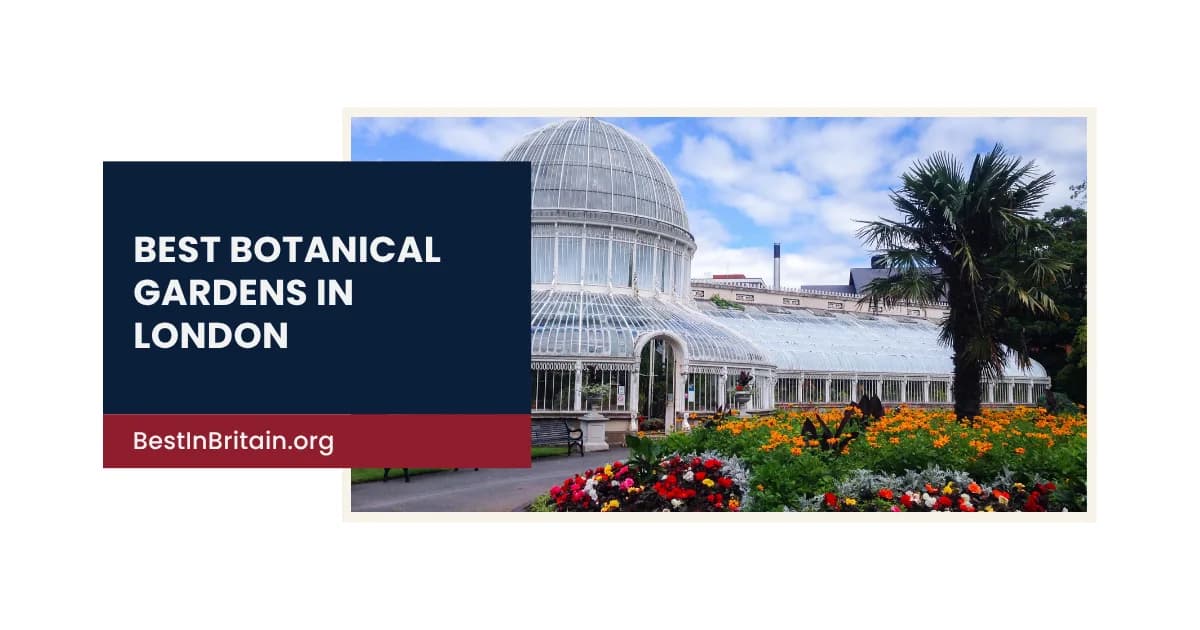
London’s botanical gardens reveal very different relationships between plants, science, architecture and urban life. Kew brings together globally important living collections, historic glasshouses and conservation research across an estate large enough to fill an entire day. Chelsea Physic Garden explains how plants have shaped medicine, food and material culture, while the Barbican Conservatory places subtropical planting within one of Britain’s most distinctive modern architectural complexes.
Elsewhere, visitors can explore grassland and prehistoric planting at the Horniman, Japanese landscape design within Holland Park and an elevated garden built above one of London’s busiest transport interchanges.
These places are not interchangeable. Some are scientific institutions with extensive labelled collections; others are designed landscapes best understood through composition, atmosphere and seasonal change. Several are free, while Kew and Chelsea Physic Garden charge admission to support their collections and programmes.
This guide covers six of London’s most rewarding botanical and horticultural destinations. Each offers a distinct reason to visit, whether the priority is plant science, historic gardening, tropical interiors, family facilities, landscape architecture or a quiet green space within the city.
Opening hours can change with the season, maintenance requirements and private events. Individual glasshouses and attractions may also close earlier than the wider grounds, so the official visitor page should be checked before making a special journey.
How to choose a botanical garden in London
The right garden depends on the amount of time available and the kind of experience the visitor wants.
Choose a major botanical institution when the priority is plant diversity, scientific interpretation and specialist collections. Kew is the clear choice for this type of day.
A smaller historic garden can provide greater depth around a particular subject. Chelsea Physic Garden concentrates on medicinal, edible and useful plants within a compact four-acre site.
Indoor conservatories are useful in poor weather, although neither the Barbican nor Kew is entirely weatherproof as a complete visit. The Barbican Conservatory is compact and opens only on selected dates, while Kew requires outdoor walking between its glasshouses.
Designed urban gardens offer a different experience. Kyoto Garden is best appreciated as a carefully composed Japanese landscape, while Crossrail Place Roof Garden demonstrates how substantial planting can be integrated into contemporary transport and commercial architecture.
Families may find the Horniman particularly practical because its gardens can be combined with museum collections, open lawns, an animal walk and separately ticketed attractions.
Before travelling, consider:
- The size of the site
- Whether admission is free or paid
- Seasonal opening and closing times
- Planned glasshouse or attraction closures
- The amount of outdoor walking involved
- Step-free routes and terrain
- Family facilities
- Cafés and places to rest
- Plant labelling and interpretation
- Whether advance booking is required
- The likely duration of the visit
Royal Botanic Gardens, Kew
Editorially SelectedBusiness details
Address
Kew, Richmond, London, TW9 3AE
Contact details: 020 8332 5655
Opening hours: Seasonal
- The gardens open daily from 10:00 AM
- Closing and last-entry times vary throughout the year
- Glasshouses, galleries and individual attractions may close before the wider gardens
Admission: Paid admission; advance online tickets generally cost less than tickets purchased at the gate
Royal Botanic Gardens, Kew is London’s most extensive botanical destination and one of the world’s leading institutions for plant and fungal science.
Its importance reaches far beyond the visitor gardens. Kew undertakes research, conservation, seed banking, identification and international collaboration, while its living collections provide a public introduction to plants from different climates and regions.
For visitors, the experience combines monumental Victorian glasshouses, specialist outdoor gardens, an arboretum, historic buildings, galleries and changing seasonal displays. The estate is large enough to support repeated visits without requiring the same itinerary twice.
The Palm House
The Palm House is one of Kew’s defining buildings.
Completed during the Victorian period, it was designed to create the warm, humid conditions required by tropical plants. Its curving glass-and-iron structure remains an important work of engineering as well as a functioning conservatory.
Inside, dense planting represents tropical environments containing species that may be threatened in their natural habitats. Palms, cycads and broad-leaved plants occupy several levels, while an elevated walkway provides a different view through the canopy.
The conditions can be hot and humid, particularly during summer. Visitors may wish to explore the Palm House earlier in the day before moving into the outdoor collections.
Kew has announced a future renovation programme for the Palm House, although it remains open ahead of that work. Visitors should check current notices before travelling because preparatory activity and conservation requirements may affect parts of the display.
The Temperate House
The Temperate House is recognised by Kew as the world’s largest surviving Victorian glasshouse.
Its collection brings together plants from temperate regions across Africa, Asia, Australasia, the Americas and oceanic islands. These climates are neither permanently tropical nor equivalent to Britain’s outdoor conditions, creating a varied collection within one enormous structure.
The building’s scale is immediately impressive, but the plants become more rewarding when considered by region. Species from islands and geographically restricted habitats can be particularly significant because small wild populations are vulnerable to habitat loss, invasive species and climate change.
Elevated walkways provide views over the central planting and reveal the architectural rhythm of the glasshouse. The structure underwent a major restoration before reopening in 2018, allowing its historic form to continue serving a modern conservation role.
Princess of Wales Conservatory
The Princess of Wales Conservatory provides the most concentrated journey through contrasting environments at Kew.
Its ten computer-controlled climate zones range from arid landscapes to humid tropical habitats. Visitors move between cacti, succulents, carnivorous plants, orchids, aquatic species and other specialised collections without crossing the full estate.
The conservatory is especially useful on a first visit because it demonstrates how differently plants adapt to heat, water scarcity, humidity and nutrient-poor environments.
Its route is more complex than the long central spaces of the Palm House and Temperate House. Allow time to explore the side paths rather than moving directly from entrance to exit.
Outdoor collections
Kew’s outdoor landscape is as important as its glasshouses.
The Arboretum contains an extensive collection of trees from around the world, arranged across broad lawns and more densely planted areas. Seasonal change gives this part of Kew a different character throughout the year, from spring blossom and fresh foliage to autumn colour and winter bark.
The Great Broad Walk Borders provide one of the garden’s most prominent formal displays. Long herbaceous borders combine colour, height and texture on a scale appropriate to Kew’s landscape.
Other areas include:
- The Rose Garden
- The Rock Garden
- The Japanese Landscape
- The Mediterranean Garden
- The Bamboo Garden
- The Kitchen Garden
- The Rhododendron Dell
- The Grass Garden
- The Natural Area
- Seasonal meadows and bulb displays
The Treetop Walkway provides an elevated route through the tree canopy. Its height and exposed position may not suit every visitor, and temporary closures can occur during maintenance or poor weather.
Architecture, galleries and history
Kew contains several buildings that broaden the visit beyond living plants.
The Great Pagoda, designed by Sir William Chambers, reflects 18th-century European interest in Chinese architecture. Access arrangements may be seasonal or separately managed.
The Marianne North Gallery contains hundreds of botanical paintings made during the artist’s travels. Rather than isolating plants from their environments, many works show species within landscapes and ecological settings.
The Shirley Sherwood Gallery presents changing exhibitions of botanical art, while Kew Palace provides a connection with royal and domestic history.
Not every attraction will be open throughout every visit. Planned closures are published by Kew and should be checked in advance.
Visiting with children
Kew’s Children’s Garden is designed for younger visitors and uses plants, play structures and landscape to explore elements connected with plant growth.
Access may be controlled during busy periods, and children must be accompanied. Families should check the current booking and capacity arrangements before relying on it as the main part of the day.
The size of Kew also means families should plan realistic walking distances. A route focused on two glasshouses, one outdoor collection and the Children’s Garden is likely to be more enjoyable than attempting the entire estate.
Best for
- A complete botanical day out
- Tropical and temperate glasshouses
- Plant science and conservation
- Historic landscape and architecture
- Trees and specialist outdoor collections
- Families planning a full-day visit
- Botanical art and garden history
- Repeat visits across different seasons
What to know before visiting
- Kew is much larger than London’s other gardens
- Admission is paid
- Online tickets usually provide better value
- Closing times change seasonally
- Individual attractions may close earlier
- Planned closures should be checked before travelling
- Considerable outdoor walking is required
- Several gates serve different parts of the estate
Editorial tip
Choose three or four priorities before arriving and enter through the gate closest to the first one. A focused visit to selected collections is more rewarding than trying to complete the entire map in one day.
Chelsea Physic Garden
Editorially SelectedView this post on Instagram
Media credits: chelsea_physic_garden
Business details
Address
66 Royal Hospital Road, London, SW3 4HS
Contact details: 020 7352 5646
Standard opening hours:
- Sunday to Friday: 11:00 AM to 5:00 PM
- Saturday: Closed, except for selected special openings
- Last entry: 30 minutes before closing
Admission: Paid admission; ticket prices vary by age and eligibility
Chelsea Physic Garden is London’s oldest botanic garden and one of the capital’s most important surviving sites connected with the study of medicinal and useful plants.
Founded in 1673 by the Worshipful Society of Apothecaries, the garden was established to support the teaching and identification of plants used in medicine. More than 350 years later, it continues to explore the relationship between plants and human life.
The four-acre site is enclosed by walls close to the Thames. Its protected position creates a relatively sheltered microclimate, allowing species from a wide range of regions to be cultivated within central London.
Chelsea Physic Garden is much smaller than Kew, but that intimacy is one of its strengths. Visitors can examine individual plants, read labels and understand how the collections are organised without walking across a large estate.
Medicinal plants
The Garden of Medicinal Plants examines species associated with health, medicine and pharmaceutical development.
Some plants have long histories in traditional systems of medicine, while others contain compounds that contributed to modern treatments. The interpretation also encourages visitors to understand that a plant’s medicinal use does not make unsupervised consumption safe.
The value of the collection lies in connecting botanical identity with social and scientific history. Plants are presented not merely as attractive specimens but as organisms that have influenced research, trade and medical practice.
Edible and useful plants
The Garden of Edible and Useful Plants broadens the story beyond medicine.
Its displays explore plants connected with:
- Food
- Drinks
- Fibres
- Dyes
- Oils
- Building materials
- Cosmetics
- Household products
- Industrial processes
- Cultural traditions
The collection demonstrates how often everyday materials originate from plants, even when the finished product no longer resembles its botanical source.
This area can be particularly engaging for visitors who do not normally consider themselves botanical enthusiasts. Familiar foods and materials provide a direct route into questions of agriculture, trade, sustainability and cultural exchange.
Historic collections and glasshouses
Chelsea Physic Garden contains several smaller glasshouses holding plants that require warmer or more controlled conditions.
They do not offer the monumental architecture of Kew’s Palm House or Temperate House. Their value lies in extending the collection into climates that cannot be maintained outdoors throughout the year.
Glasshouse admission is included within the main ticket, although restoration or horticultural work can occasionally affect access.
The Pond Rockery is another historically important part of the site. Created during the 18th century, it is regarded as one of Europe’s oldest rock gardens and demonstrates an early approach to combining stone, water and specialised planting.
Other collections examine botanical classification, island plants, woodland environments and the historical development of the garden itself.
A garden for close observation
Chelsea Physic Garden rewards visitors who read labels and interpretation.
At Kew, a glasshouse or mature tree can create an immediate sense of scale. At Chelsea, the significance of a modest-looking specimen may lie in its chemical properties, cultural use or role in botanical history.
Guided tours are therefore particularly worthwhile. A knowledgeable guide can draw attention to plants that might otherwise be passed without recognising their importance.
The site can usually be explored comfortably within two or three hours, although visitors attending a tour, workshop or meal may spend longer.
Food, events and learning
The garden operates a café and hosts a programme of talks, practical workshops, family activities and seasonal events.
Special evening openings, performances and dining events may operate under different ticketing arrangements from ordinary admission.
Anyone visiting for a particular event should confirm whether general garden access is included and how long the site remains open afterwards.
Best for
- Medicinal and useful plants
- The history of botanical science
- Food, fibres, dyes and plant-based materials
- An intimate central London garden
- Guided tours and close observation
- Visitors who prefer depth to scale
- A two- or three-hour cultural visit
What to know before visiting
- The garden is normally closed on Saturdays
- General admission is paid
- Last entry is 30 minutes before closing
- Special events may have separate tickets
- The site is compact compared with Kew
- Guided interpretation adds considerable value
- Opening arrangements can change seasonally
Editorial tip
Join a tour when one aligns with the visit. Many of the garden’s most compelling stories concern the uses and histories of plants that may appear visually understated.
Barbican Conservatory
Editorially SelectedView this post on Instagram
Media credits: drcherylmackenzie
Business details
Address
Barbican Centre, Silk Street, London, EC2Y 8DS
Contact details: 020 7870 2500
Opening hours: Selected public-opening dates only
Admission: Free; timed booking is normally required
The Barbican Conservatory is one of London’s most distinctive indoor gardens.
Built within the Barbican Centre, it brings tropical and subtropical planting into direct contact with concrete terraces, theatre structures and the layered walkways of the wider estate.
The conservatory was developed during the early 1980s and opened in 1984. Its planting now includes approximately 1,500 species and varieties of plants and trees.
Visitors encounter palms, tree ferns, succulents, climbing plants and species from regions including South Africa and Brazil. Some plants are rare or threatened in their natural environments, while ponds contain ornamental fish and terrapins.
Plants and brutalist architecture
The relationship between planting and architecture is the central reason to visit.
The Barbican was designed as a dense post-war urban complex combining homes, cultural venues, elevated walkways and public spaces. The conservatory introduces a living landscape into that geometric environment.
Plants climb across walls and terraces, soften edges and create layered views through the concrete structure. In places, the building appears to frame the vegetation; elsewhere, mature plants obscure or overtake parts of the architecture.
The result is neither a conventional greenhouse nor a formal botanical display. It feels like an interior landscape that has developed within the cultural centre over several decades.
A compact indoor visit
The conservatory is considerably smaller than Kew and can usually be explored within an hour.
Its route includes steps, bridges, narrow sections and planted terraces. Visitors with access requirements should review the current Barbican guidance when booking.
The warm interior makes it an appealing poor-weather destination, although the surrounding Barbican routes may still involve some outdoor walking.
Photography is popular because of the contrast between large leaves, reflective water and concrete. Visitors should remain considerate of other guests and avoid blocking the narrower paths.
Selected opening dates
The most important practical point is that the conservatory is not open every day.
Public visits take place only on dates listed by the Barbican. Timed tickets are released online, and the conservatory remains closed to public visits on dates that do not appear in the booking calendar.
A limited number of same-day tickets may occasionally be released, but availability should not be assumed.
The Barbican Centre’s general opening hours do not indicate whether the conservatory is accessible. A specific conservatory booking should be secured before travelling.
Combining the visit
The Barbican contains cinemas, concert venues, theatre spaces, a library, cafés and changing exhibitions.
Its lakeside terraces and elevated walkways are also worth exploring. Visitors interested in architecture may wish to join an estate tour or allow time to walk through the residential and cultural complex.
The conservatory can also be combined with Smithfield, St Bartholomew the Great, the City of London and nearby galleries.
Best for
- Tropical and subtropical planting
- Brutalist architecture
- A free indoor garden
- Photography
- A short cultural visit in the City
- Combining plants with a Barbican event
- Visitors seeking an unusual London interior
What to know before visiting
- The conservatory opens only on selected dates
- Timed booking is normally required
- General Barbican hours do not apply to conservatory access
- Same-day tickets are limited and not guaranteed
- The interior can be warm and humid
- The route is compact
- Security and bag checks may operate at the entrance
Editorial tip
Choose the conservatory date first and arrange the rest of the day around it. Its limited opening schedule makes it less suitable for a spontaneous visit than London’s public parks and gardens.
Horniman Gardens
Editorially SelectedView this post on Instagram
Media credits: hornimanmuseumgardens
Business details
Address
100 London Road, Forest Hill, London, SE23 3PQ
Contact details: 020 8699 1872
Standard opening hours:
- Monday to Saturday: From 7:15 AM
- Sunday and bank holidays: From 8:00 AM
- Closing is normally at 8:30 PM
- The gardens close on selected dates during the year
Admission: Free for the gardens; charges apply to the Butterfly House, aquarium and selected exhibitions or events
Horniman Gardens form a 16-acre landscape around the Horniman Museum in Forest Hill.
The site combines horticultural displays, lawns, family facilities, ecological areas and broad views across London. Its character is less formal than Kew or Chelsea Physic Garden, but several areas use plants to explore scientific, historical and environmental themes.
The gardens work particularly well as part of a combined museum day. Visitors can move between indoor collections and outdoor spaces without paying general admission, while separately ticketed attractions add further options for families.
Grasslands Garden
The Grasslands Garden draws inspiration from habitats including North American prairie and South African grassland.
Rather than presenting ornamental planting only for colour, it demonstrates how grasses and flowering plants can be assembled to evoke larger ecosystems.
Grasslands support complex communities of insects, birds and other wildlife, yet many are threatened by development, intensive agriculture and environmental change.
The planting has strong seasonal variation. Fresh growth and flowers dominate during the warmer months, while seed heads, stems and grasses maintain texture later in the year.
This makes it a useful example of naturalistic planting that remains visually interesting beyond a brief flowering period.
Prehistoric Garden
The Prehistoric Garden contains plants connected with ancient evolutionary lineages.
Tree ferns, cycads and monkey puzzle trees evoke plant groups that existed long before flowering plants became dominant.
One of the most notable specimens is the Wollemi pine. The species was known through fossils before living trees were identified in Australia in 1994.
Its discovery attracted international attention and transformed a plant thought to belong only to the distant past into an urgent conservation concern.
For children, the Prehistoric Garden provides an accessible link between living plants, fossils and deep time. Adults may find it equally valuable as a reminder that conservation protects evolutionary history as well as attractive landscapes.
Dye Garden and other collections
The Dye Garden explores plants historically used to produce colour for textiles and other materials.
Different roots, leaves, flowers, bark and fruits can yield pigments, although the resulting colours and processes may be less predictable than modern synthetic dyes.
The garden connects horticulture with craft, trade and cultural history. It also demonstrates how plants have supplied materials for human use beyond food and medicine.
Other areas include:
- The Sunken Garden
- Tree collections
- A nature trail
- Wildlife planting
- Formal and informal lawns
- Seasonal displays
- An animal walk
The elevated site provides views towards central London, making the gardens attractive even to visitors without a specialist botanical interest.
Families and facilities
Horniman is one of the most family-friendly choices in this guide.
The museum, gardens, aquarium, animal walk and Butterfly House create enough variety for several hours. The gardens themselves are free, while the Butterfly House and aquarium require separate tickets.
Families should book ticketed attractions in advance during weekends and school holidays.
Open lawns provide space for children to move between more structured parts of the visit. Food and drink facilities operate on site, although individual kiosk hours can vary seasonally.
Access and terrain
Much of the garden is accessible, but the site includes slopes and some uneven paths.
Visitors with mobility requirements should consult the Horniman’s access information before planning a complete route.
The gardens open early and remain accessible into the evening for much of the year. Selected closure dates apply, so the calendar should be checked before travelling.
Best for
- Families
- Free botanical and educational displays
- Grassland and naturalistic planting
- Ancient plant lineages
- Views across London
- Combining a museum with outdoor space
- A half-day or full-day visit
- South-east London residents and visitors
What to know before visiting
- The gardens are free
- The Butterfly House and aquarium are ticketed separately
- The site includes slopes and uneven sections
- Opening begins later on Sundays and bank holidays
- Selected annual closure dates apply
- Events can affect the atmosphere and use of particular areas
- Families should book paid attractions in advance
Editorial tip
Plan the day around a combination of the museum and gardens rather than treating either as a brief addition. The range of displays and family facilities can comfortably fill several hours.
Kyoto Garden
Editorially SelectedView this post on Instagram
Media credits: kelly_xm_
Business details
Address
Holland Park, London, W11 4UA
Opening hours:
- Holland Park opens daily from 7:30 AM
- The park closes at dusk
- Seasonal closing times are displayed at the entrances
- Some gates may close shortly before the advertised park closing time
Admission: Free
Kyoto Garden is a Japanese-style landscape within Holland Park.
Opened in 1991, it was created as a gift from the Chamber of Commerce of Kyoto to commemorate the relationship between Japan and the United Kingdom.
The garden is modest in size, but its planting, stonework and water have been composed to produce a sequence of balanced views rather than an extensive botanical collection.
A tiered waterfall flows into a pond containing koi. Stone lanterns, clipped shrubs, rocks and carefully positioned trees create a landscape that changes subtly as visitors move around the path.
Japanese landscape design
Kyoto Garden is best understood through composition rather than plant quantity.
Views are framed by foliage and changes in ground level. Rocks and water provide structure, while planting softens the transitions between the garden’s elements.
The waterfall introduces movement and sound, helping separate the space from the wider activity of Holland Park. Reflections in the pond add another layer to the composition.
Individual features are not intended to compete for attention. Their effect comes from the way water, stone, planting and open space operate together.
Seasonal character
The garden changes significantly through the year.
Spring blossom introduces a brief period of delicate colour. Summer foliage creates a denser and more enclosed atmosphere, while Japanese maples provide some of the garden’s most vivid autumn displays.
Winter reveals the structural qualities of branches, rocks and water more clearly.
There is therefore no single best season, although spring blossom and autumn colour attract the largest numbers of visitors.
Wildlife and Holland Park
Koi are among the most recognisable inhabitants of the pond, and peacocks from the wider park are frequently seen nearby.
Visitors should avoid feeding or disturbing wildlife and remain on the designated paths.
Kyoto Garden occupies only a small part of Holland Park. A visit can be extended through woodland areas, formal gardens, sports facilities and other landscaped sections.
The nearby Fukushima Memorial Garden was opened in 2012 as an expression of gratitude for British support following the 2011 earthquake, tsunami and nuclear disaster in Japan.
A popular and compact space
Kyoto Garden can become very busy.
Its paths are relatively narrow, and photographers may remain at particular viewpoints. Weekends, blossom season and peak autumn colour are especially popular.
For a quieter experience, visit soon after Holland Park opens on a weekday.
The garden is not designed as a major half-day botanical destination. Most visitors will spend between 20 and 45 minutes inside, depending on crowds and interest in photography.
Its value lies in atmosphere, landscape detail and its relationship with the wider park.
Best for
- Japanese garden design
- Seasonal colour
- Photography
- A quiet morning walk
- A free Kensington activity
- Combining with a longer Holland Park visit
- Water, stone and landscape composition
What to know before visiting
- The garden is small
- Admission is free
- It can become crowded
- Holland Park closes at dusk
- Some gates close before the final advertised time
- The paths should be kept clear for other visitors
- It is a designed landscape rather than a scientific botanical collection
Editorial tip
Arrive shortly after 7:30 AM on a weekday. Early morning provides the best opportunity to hear the waterfall and appreciate the composition before the paths become busy.
Crossrail Place Roof Garden
Editorially SelectedBusiness details
Address
Crossrail Place, Canary Wharf, London, E14 5AR
Opening hours:
- Open daily
- The garden normally remains open until 9:00 PM
- Summer access may end at sunset
- Events and maintenance can occasionally affect access
Admission: Free
Crossrail Place Roof Garden is an elevated urban garden built above Canary Wharf’s Elizabeth line station.
The space forms part of the Crossrail Place development, where a curved timber-and-glass roof shelters dense planting, pathways, seating and an amphitheatre.
Unlike a sealed conservatory, the roof is partially open to the weather. Natural air, rain and changing light enter the space while the structure still provides a strong sense of enclosure.
Planting across the meridian
The garden’s design responds to the site’s proximity to the Greenwich meridian.
Planting is arranged broadly according to the eastern and western hemispheres. Asian species, including bamboos, appear towards one side, while plants associated with the Americas and other western regions occupy the other.
The division should not be interpreted as a comprehensive scientific map. It functions as a design concept that gives the planting a geographical narrative within a relatively compact space.
Visitors move along gently curving paths between foliage, benches and small clearings. The planting can feel unexpectedly dense given that offices, shops, restaurants and transport infrastructure surround the site.
Architecture and engineering
The roof is one of the garden’s defining features.
Its timber lattice curves over the planting while triangular transparent panels admit light. Open sections allow rain and air to reach the plants, creating conditions closer to an outdoor garden than a conventional greenhouse.
This relationship between infrastructure and landscape makes Crossrail Place particularly interesting for visitors interested in contemporary architecture.
The garden demonstrates that substantial public planting can be integrated into a high-density commercial development rather than placed only at ground level.
Amphitheatre and events
An amphitheatre within the garden hosts performances, talks and community events.
These can add energy to the space, but they also change its atmosphere. Visitors looking for a quiet walk may prefer to check the Canary Wharf events calendar before travelling.
The garden is generally calmest at weekends, earlier in the day and outside weekday commuter periods.
Office workers use the space during lunch breaks, while evening visitors may encounter diners and people attending events elsewhere in Canary Wharf.
An accessible urban stop
Crossrail Place is extremely easy to reach.
The Elizabeth line, Jubilee line and Docklands Light Railway connect Canary Wharf with central, east and south-east London. The roof garden is integrated into the wider station and retail complex.
The Museum of London Docklands, riverside walks, public art and other Canary Wharf open spaces can all be combined with the visit.
The garden is not comparable with Kew in plant diversity or Chelsea Physic Garden in scientific interpretation. Plant labelling is limited, and most visitors will complete the route within 30 to 60 minutes.
Its success lies in providing a free, attractive and carefully designed public landscape within a densely developed part of London.
Best for
- Contemporary landscape architecture
- A free Canary Wharf activity
- Evening visits
- Urban planting
- A short pause during a wider itinerary
- Combining with the Museum of London Docklands
- Visitors travelling on the Elizabeth line
- Architecture and public-space design
What to know before visiting
- Admission is free
- The garden opens daily
- Normal closing is 9:00 PM or sunset during summer arrangements
- Events can make the amphitheatre area busier
- Plant interpretation is lighter than at a botanical institution
- The garden can usually be explored within an hour
- Maintenance may occasionally affect access
Editorial tip
Visit on a weekend morning or outside weekday lunch hours for a calmer experience. Continue towards the Museum of London Docklands or the riverside to create a more substantial half-day itinerary.
Comparing London’s botanical gardens
| Garden | Area | Main experience | Admission | Typical visit |
|---|---|---|---|---|
| Royal Botanic Gardens, Kew | Richmond | Major botanical collections, glasshouses and landscape | Paid | Half day to full day |
| Chelsea Physic Garden | Chelsea | Medicinal, edible and useful plants | Paid | Two to three hours |
| Barbican Conservatory | City of London | Tropical planting and brutalist architecture | Free, booking required | Around one hour |
| Horniman Gardens | Forest Hill | Educational gardens, family facilities and views | Free | Half day |
| Kyoto Garden | Holland Park | Japanese landscape design | Free | 20 to 45 minutes |
| Crossrail Place Roof Garden | Canary Wharf | Contemporary elevated urban garden | Free | 30 to 60 minutes |
Which London botanical garden should you choose?
Choose Kew Gardens for the most complete botanical experience. Its glasshouses, arboretum, scientific interpretation and historic buildings justify a dedicated day.
Choose Chelsea Physic Garden for a concentrated exploration of medicinal, edible and useful plants within an intimate historic setting.
Choose Barbican Conservatory for tropical planting surrounded by brutalist architecture, provided a suitable public-opening date is available.
Choose Horniman Gardens for a free family day combining horticulture, museums, open space and educational displays.
Choose Kyoto Garden for Japanese landscape design, seasonal colour and a short reflective walk within Holland Park.
Choose Crossrail Place Roof Garden for a free contemporary garden that can be included easily within a Canary Wharf or Docklands itinerary.
Best botanical garden for a full day
Kew is the only garden in this selection that consistently merits an entire day.
A practical first-visit itinerary could include:
- The Palm House
- The Princess of Wales Conservatory
- Lunch or a café break
- The Temperate House
- One outdoor specialist garden
- The Arboretum or a gallery
Attempting every major attraction is likely to reduce the time available to appreciate any one collection.
Families may wish to replace one glasshouse with the Children’s Garden, while visitors interested in art can include the Marianne North or Shirley Sherwood galleries.
Best garden for botanical history
Chelsea Physic Garden provides the clearest connection between plants, medicine and the history of scientific teaching in London.
Its compact collections demonstrate how species have been identified, cultivated and used over more than three centuries.
Kew also contains substantial historical material, particularly through its architecture, galleries and role in botanical collecting. Its story is broader and requires more time to explore.
Best garden for families
Horniman Gardens provide the most flexible family experience.
The free gardens can be combined with museum displays, the animal walk and lawns, while the aquarium and Butterfly House provide optional ticketed activities.
Kew also has strong family facilities, but admission costs and the scale of the estate make the visit more demanding.
Kyoto Garden and Crossrail Place can interest children for a shorter period, although neither offers the same range of dedicated family attractions.
Best garden for architecture
The Barbican Conservatory and Crossrail Place Roof Garden offer two contrasting examples of plants integrated into major urban buildings.
At the Barbican, mature subtropical planting softens and occupies a concrete modernist structure.
At Crossrail Place, a purpose-designed timber roof creates an elevated public garden above transport infrastructure.
Kew provides a third architectural experience through its Victorian glasshouses, galleries, pagoda and historic landscape buildings.
Best free botanical experience
Horniman Gardens provide the most extensive free outdoor experience in this selection.
The Barbican Conservatory offers the strongest free indoor collection, although its opening dates are limited.
Crossrail Place Roof Garden is the easiest free garden to visit spontaneously, while Kyoto Garden offers one of London’s most carefully composed small landscapes.
Best garden for poor weather
The Barbican Conservatory is the most compact indoor option, but a suitable public-opening date must be booked.
Kew’s Palm House, Temperate House and Princess of Wales Conservatory provide substantially more indoor planting. Visitors will still need to walk outside between them, and individual glasshouse closures should be checked in advance.
Crossrail Place has a roof but remains partially open to the weather.
A two-day London garden itinerary
Day one: Kew and Richmond
Spend the first day at Kew Gardens.
Begin with the Palm House and nearby collections before moving towards the Princess of Wales Conservatory. After lunch, continue to the Temperate House and one part of the Arboretum.
Avoid adding another major attraction unless the Kew visit is deliberately short. The estate deserves enough time to explore without constant attention to the clock.
Day two: Chelsea, Kensington and Holland Park
Begin at Chelsea Physic Garden when it opens.
Allow around two hours for the collections, then continue towards Kensington. After lunch, walk through Holland Park and visit Kyoto Garden.
This itinerary combines scientific and historical botanical interpretation with a designed landscape and broader park.
Alternative: City gardens and architecture
Book a Barbican Conservatory session and explore the surrounding estate.
Continue east by Elizabeth line or Underground to Crossrail Place Roof Garden in Canary Wharf. The two sites demonstrate very different approaches to combining plants with large urban developments.
Planning a botanical-garden visit
London gardens can change substantially with the season.
Spring brings bulbs, blossom and fresh leaves. Summer provides the fullest herbaceous planting, while autumn highlights trees, seed heads and changing foliage. Winter offers a clearer view of garden structure and makes glasshouses especially appealing.
Before travelling:
- Check the current opening hours
- Review planned attraction closures
- Book tickets where required
- Examine the weather forecast
- Wear suitable footwear
- Consider the walking distance
- Review the access information
- Check café and toilet availability
- Confirm whether special events affect entry
- Allow more time than a standard museum visit
Botanical institutions care for living collections. Temporary closures, horticultural work and seasonal changes are a normal part of their operation rather than an indication that the wider garden is unavailable.
Accessibility
Accessibility differs significantly between the venues.
Kew provides step-free routes and mobility information, but the size of the estate can present challenges even where individual paths are accessible.
Chelsea Physic Garden is compact, although historic surfaces and narrow areas should be reviewed through its current access information.
The Barbican Conservatory includes a complex interior route within an existing building. Visitors should check the accessibility guidance attached to the selected booking date.
Horniman Gardens contain slopes and uneven paths, while Kyoto Garden is reached through the wider terrain of Holland Park.
Crossrail Place is integrated into a modern station and commercial development, with lifts and step-free routes available within the wider complex.
Anyone with a specific requirement should contact the venue directly before travelling rather than relying only on general descriptions.
Our selection approach
Best in Britain reviews publicly available information about each garden’s collections, historical importance, design, visitor facilities, accessibility and value within a London itinerary.
Inclusion does not mean that every site meets the formal definition of a botanic garden. Kyoto Garden and Crossrail Place Roof Garden are included because they provide distinctive horticultural and landscape experiences that broaden the guide beyond scientific institutions.
Opening times, admission prices, public access and individual attraction availability can change. Visitors should consult the official venue information before travelling.
London SEO & Digital Agency Market Statistics
Active Digital & SEO Agencies
6,800
Registered in EC/WC/W/N/E/SE/SW area
New Agencies (2026 H1)
+540
Incorporated in H1 2026
Median Agency Lifespan
4.8 yrs
Sector maturity index
Emerging Agencies (<3 Yrs)
42%
High market innovation
Top Agency Location Clusters in London
- EC1 (Clerkenwell & Tech City)28% cluster
- W1 (Soho & Fitzrovia)24% cluster
- EC2 (Shoreditch & Financial Qtr)24% cluster
- WC2 (Covent Garden & Strand)24% cluster
Agency Capabilities & Multi-SIC Specialisms
- Advertising & Search Marketing (SIC 73110)Core (100%)
- Technical SEO & Web IT Consultancy (SIC 62020)34% of firms
- Bespoke Web & Software Development (SIC 62012)22% of firms
- Strategic Brand & Growth Advisory (SIC 70229)18% of firms
Related articles
Related guides

Things to Do
Best Jazz Clubs in London for Live Music
A current guide to six London jazz clubs and live-music venues, covering ticket prices, seating, food, age rules, accessibility, jam sessions and the different styles each venue presents.
Updated 22 July 2026

Things to Do
Best Ice Skating Rinks in London
A current guide to London's best year-round ice skating rinks, covering public sessions, prices, skate hire, lessons, family rules, accessibility and seasonal rink updates.
Updated 13 July 2026

Things to Do
Best Live Music Venues in London
A current guide to six London live music venues, covering concert formats, standing and seating, accessibility, bag rules, age restrictions, food, ticket fees and choosing the right room.
Updated 13 July 2026

Things to Do
15 of the best walking tours in London for curious wanderers
Discover 15 standout London walking tours, covering royal ceremony, wartime Westminster, women’s history, Harry Potter, Sherlock Holmes, street art, food, pubs and architecture.
Updated 12 July 2026

Things to Do
12 of the best tours in London for memorable city experiences
Discover 12 standout London tours, including Harry Potter, sightseeing buses, Thames cruises, food walks, cycling, theatre history and specialist neighbourhood experiences.
Updated 11 July 2026

Things to Do
30 of the best free things to do in London for locals and visitors
Discover 30 of the best free things to do in London, from major museums and royal parks to historic ceremonies, skyline views, live music and unusual attractions.
Updated 5 July 2026
Know a business we should consider?
Send us the details and our editorial team will review whether it fits a future guide.
Submit businessWriter profile
Gabriela K.
Arts, Culture & Performance Editor
Actor, theatre director and Queen Margaret University Drama graduate with international performance experience across Edinburgh, London, New York, Paris and Venice. Gabriela has performed in and directed Edinburgh Festival Fringe productions and covers theatre, performing arts, cultural venues, live entertainment, festivals and the creative industries for Best in Britain.
Editorial Trust Standard
Independent ReviewIndependent Research
Featured rankings are editorially determined. Commercial partner listings are strictly labeled as Sponsored or Featured.
Public Register Audit
Listings are cross-checked against public regulatory registries, Companies House filings, and published fee schedules.
Regional Directory
Explore Other Verified Services in London
accountants
Top Accountants in London
marketing agencies
Top digital marketing agencies in London
private clinics
Best Home Care Services in London
solicitors
Best Immigration Lawyers in London
things to do
Best Jazz Clubs in London for Live Music
commercial property agents